A Solar Power Plant vendor running India's Surya Ghar solar subsidy scheme replaced a physical document and data collection process with a fully automated workflow.

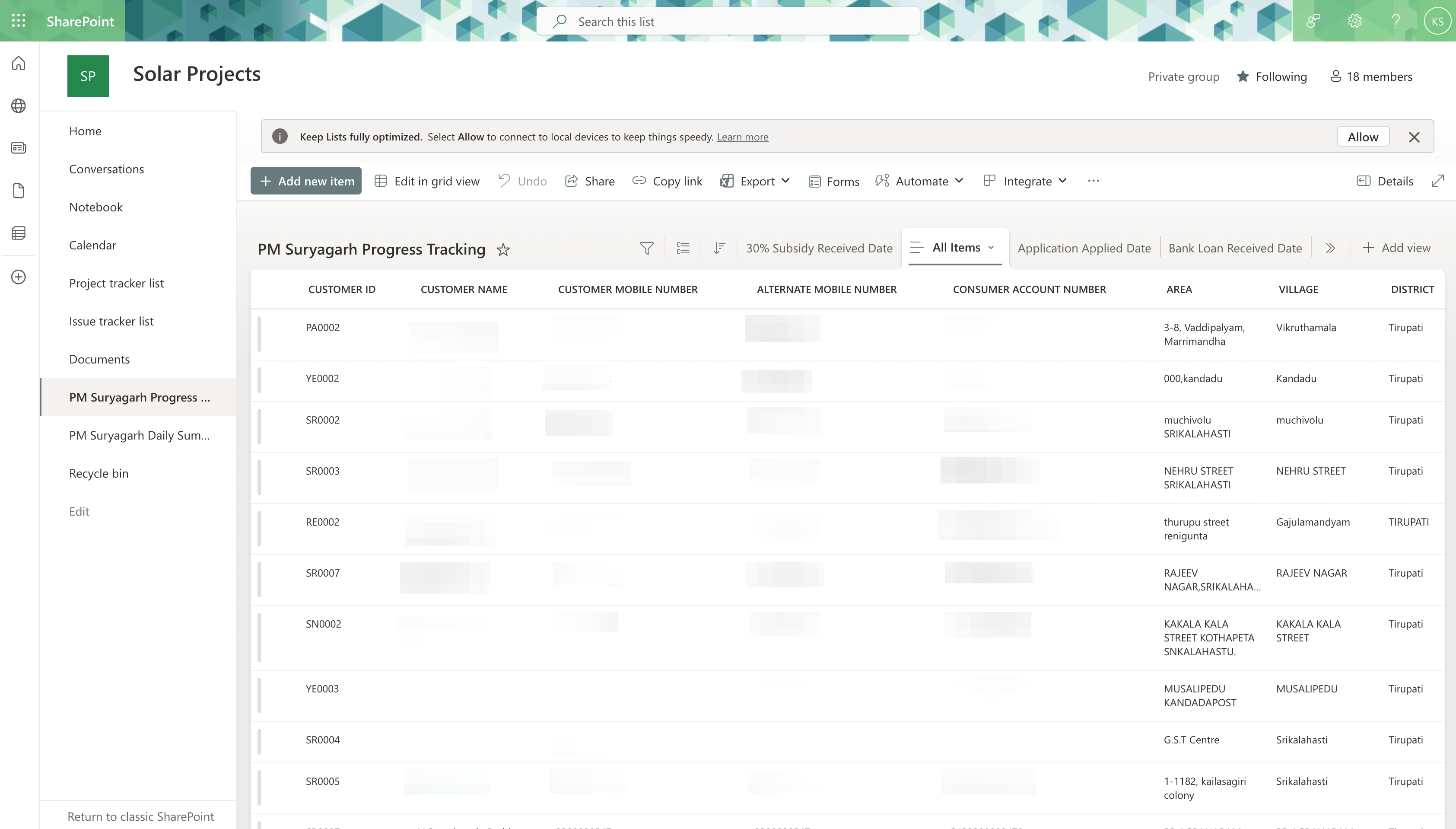
The company needed a better organized workflow to manage customer applications under the Surya Ghar government solar scheme. Multiple agents covered different areas, conducting home surveys, collecting documents, and reporting status manually. The workflow was dependent on manual steps at every stage.
The objective was to build a structured, organized system that reduced manual effort across document handling, status tracking, and reporting. Success meant measurable time savings, a clear folder structure per customer, and a single view of application status across all stages.
Multiple agents covered different areas. As applications grew under the Surya Ghar scheme, the time spent on manual tasks grew with them.
Agents uploaded scanned documents to a shared drive with no folder per customer. Finding a specific customer's file meant searching through hundreds of uploads with no consistent naming convention.
After each field visit, staff had to rename uploaded files, cross-reference form entries with a Google Sheet.
The workflow had four stages: field survey, loan approval, post-completion documents, and overall tracking. There was no unified view showing where each customer stood. The solar team had to check records individually to determine status.
Each stage of the Surya Ghar workflow was reviewed in detail: field survey, loan approval, post-completion agreements, and tracking. Data types, document requirements, and manual steps were documented before any tool was configured.
MS Forms were designed for each stage with correct fields, validations, and dropdowns. SharePoint lists were structured to match, with columns for customer ID, stage status, document links, loan approval status, and area. Per-customer folder structure and access control were configured at this stage.
Power Automate flows were built to handle all post-submission tasks: column mapping, customer ID generation, folder creation, document upload, link storage, and date calculation. After a demo review with the solar team, image-to-PDF conversion, PDF naming using customer name and ID, and Aadhaar file naming were added.
Power BI dashboard configured for the solar team's oversight by area and stage. Power Apps interface deployed for agents and managers with an on-demand daily summary option. System confirmed live across all areas.
The workflow was rebuilt using Microsoft 365 tools. MS Forms replaced document forms with structured inputs. Power Automate eliminated all manual post-submission work, cutting processing time by 85%+. SharePoint holds every customer record in its own access-controlled folder. Power BI and Power Apps give the solar team and agents a unified view without switching tools or checking files manually.
A new form was built in MS Forms for each stage with the required fields, validations, and dropdowns. Agents submit structured data from the field without ambiguity, replacing the free-text inputs that previously produced inconsistent records.
On form submission, Power Automate maps data to SharePoint, generates a customer ID, creates a dedicated folder per customer, uploads documents with correct names, stores document links, and auto-fills calculated fields such as dates seven days from submission. Tasks that previously required hours of manual work per day are completed in seconds, cutting processing time by 85%+.
A Power BI dashboard gives the solar team a live overview of applications by area, stage, and loan status. Power Apps provides agents and managers with an interface for progress tracking and record lookup. A generate daily summary option lets managers produce summaries on demand via Power Automate.
Manual processing time reduced by 85%+ across the agent team.
Agents submit field data once. No manual renaming or cross-referencing required after submission.
Every customer has a dedicated SharePoint folder with correctly named documents and controlled access.
The solar team views the status of all applications across all areas from a single Power BI dashboard.
Full process coverage from field survey to post-completion agreements in one system.
Managers generate daily summaries on demand using Power Apps.
The workflow runs entirely on the Microsoft license the team already held.
The clearest indicator of impact was time. Mapping each manual step before building anything made it possible to measure what the automation actually saved.
The existing forms setup was built without automation in mind. Understanding each stage before building anything prevented rework and ensured the new system matched how agents actually work in the field.
Flat storage with open access works for small teams. With multiple agents across areas and sensitive customer documents, per-customer folders with proper access control in SharePoint became essential.
Replacing open comment fields with structured dropdowns eliminated inconsistency before it entered the system. Agents did not have to remember what to type. The solar team received clean, filterable data without manual cleanup.
Finalizing fields, validations, and naming logic in MS Forms before building the Power Automate flow kept the automation stable from the start. Rushing to automation with an unfinished form would have required rebuilding the flow repeatedly.
This solar vendor transitioned from a manual data collection process to a fully integrated Microsoft 365 automation engine. By replacing physical document handling with an end-to-end digital workflow, the company reduced manual processing time. Every customer record is now automatically organized into secure, access-controlled folders, while real-time dashboards provide full operational visibility across all regions. The result is a highly scalable system that allows the team to focus on solar deployments instead of administrative bottlenecks.
If your team is managing field submissions, document collection, and status tracking with manual steps, the Microsoft 365 tools you already have can do the work automatically.

Replacing manual drawing review across departments with automated extraction and formula-driven calculations for supercritical boiler fabrication.

Extracting dimensions with abbreviations filtering and confidence-scored outputs from engineering drawings at scale.

A unified platform for generating and managing encryption keys across products, geographies, and customers.