Read with Claude
 Read with ChatGPT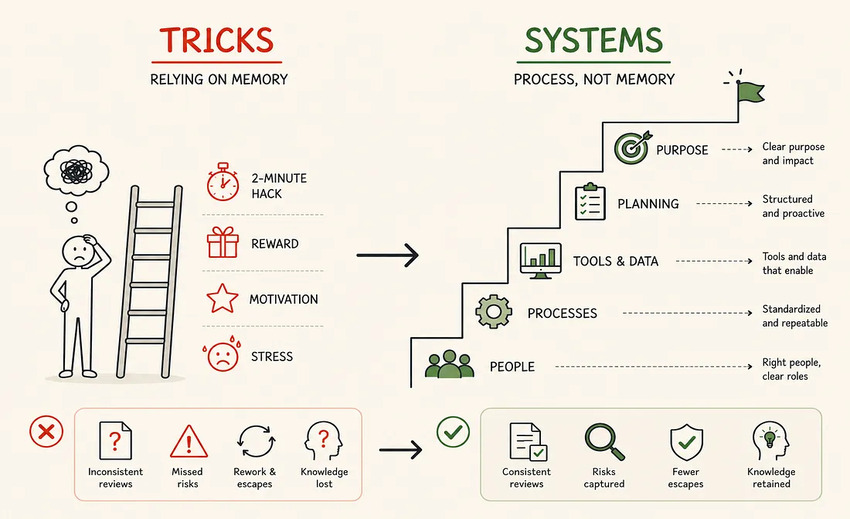
A Process Failure Mode and Effects Analysis (PFMEA) review can go smoothly and still miss key information. In most organizations, the knowledge used during a PFMEA review exists only in the experience of the Supply Quality Engineer (SQE) or reviewer rather than being documented.
One reviewer or SQE remembers a failure mode from a similar part and process two years ago. Another knows which supplier underestimates severity ratings. When the reviewer is replaced, the same document can pass through with none of those checks applied.
The below six gaps explains that the problem is not sloppiness. It’s the review process and knowledge were never documented and applied consistently across review but resides in people’s experience.
Gap 1: Lack of Standardized PFMEA Submissions
- Suppliers often submit PFMEAs using different templates, structures and importantly addressing or describing failure modes, effects and causes etc., in different ways.
- Although reviewers assess the same process risk they must interpret how each supplier has conveyed the information before evaluating the risks.
A standardized PFMEA format allows reviewers to spend less time interpreting documents and more time assessing process risk.
Gap 2: Undefined Review Triggers
- Suppliers often submit multiple PFMEAs or revisions together as part of a Production Part Approval Process (PPAP)
- Reviewing every record line by line is rarely feasible.
Without a way to prioritize which PFMEAs or process steps require deeper review, SQEs must rely on their own judgment to decide where to focus.
Also, the, depth and focus of the review can vary between reviewers.
Gap 3: Missing Ownership and Accountability
- Identifying a risk or anomaly is part of the PFMEA review.
- Every finding should move through a defined workflow: assign an owner, set a due date, implement the action, verify its effectiveness, and update the PFMEA.
Without a structured follow-up process, risk can remain open across review cycles or be closed without confirming that the underlying process risk has been effectively addressed.
Gap 4: Limited Change Traceability
- Most organizations can identify the current revision of a PFMEA.
- However, understanding what changed between revisions, why those changes were made, and who approved requires manually comparing PFMEAs.
Without clear change traceability, reviewers often spend time rereading the entire PFMEA instead of focusing on what has actually changed.
Gap 5: Limited Cross-PFMEA Validation
- A failure mode identified in one PFMEA also apply to similar part and processes.
- The AIAG-VDA methodology encourages organizations to carry these lessons forward.
In practice, however, this often depends on someone remembering a previous project rather than on a system that connects related PFMEAs.
Gap 6: Completion vs. Effectiveness
A PFMEA review can be marked as “Complete” without being truly effective. Review delivered real value is rarely measured
- Completion focuses on activity, the review meeting was held, comments were documented, and approvals or sign-offs were recorded
- Effectiveness focuses on outcome, the review actually identified meaningful risks, gaps, or improvement opportunities that matter to process quality, safety, and customer satisfaction.
Why These Are Process Design Challenges, Not Individual Performance Issues
These six gaps are not caused by a lack of knowledge or experience.
The real issue is consistency and process:
- If review quality depends on who performs the PFMEA review, the process is not providing enough structure to guide the outcome.
- A well-designed review process should define what gets reviewed, how changes are traced, and how lessons learned are reused.
- That allows reviewers to focus on engineering judgment instead of deciding what to review or relying on memory to fill process gaps.
Experience will always improve a review, but the process should ensure that critical checks happen consistently, regardless of who is conducting it.
Designing a PFMEA Workflow That Doesn’t Depend on Memory
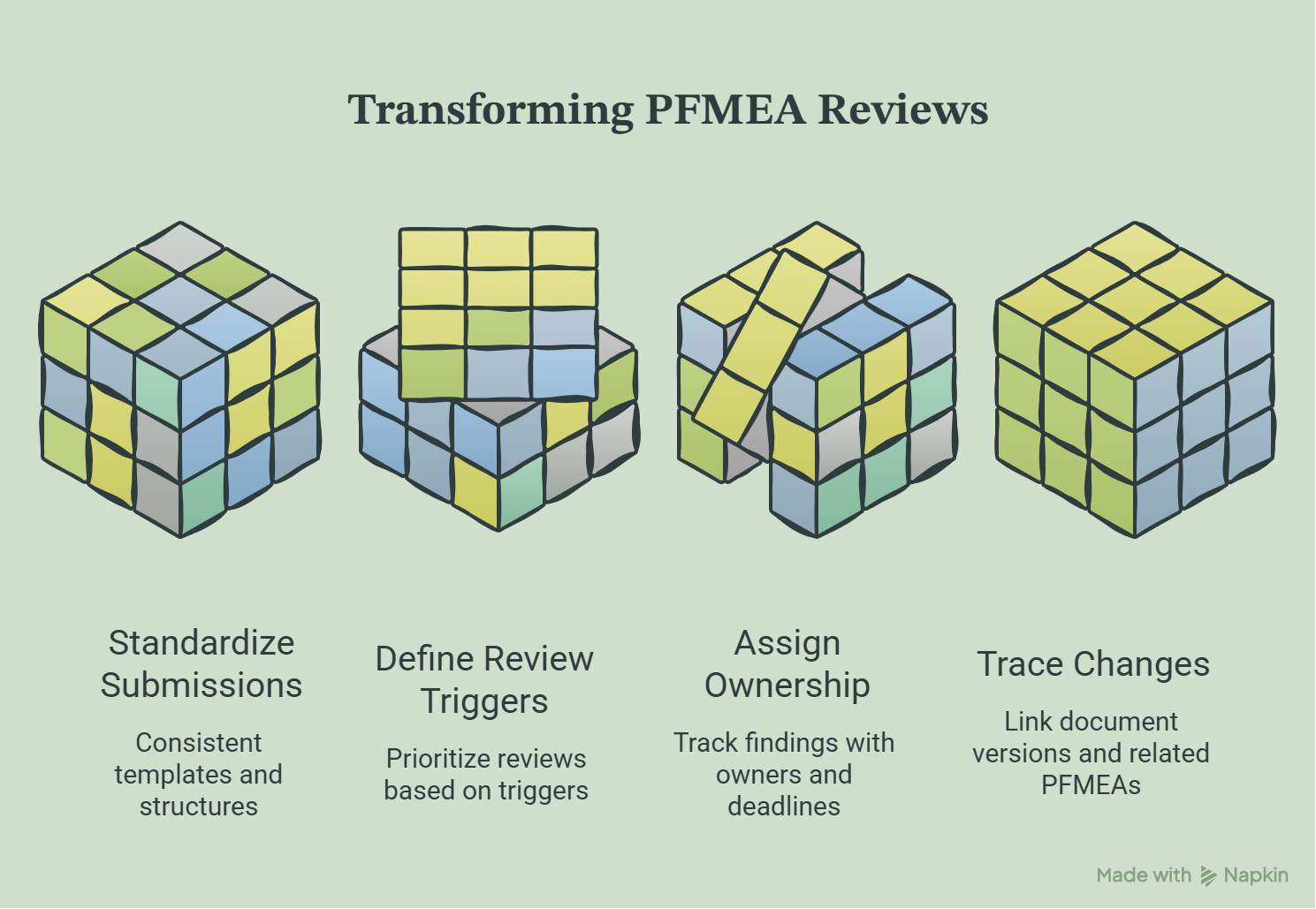 Addressing these gaps requires more than experienced reviewers. It requires a review process that standardizes documentation, prioritizes reviews, tracks actions, maintains traceability, and captures organizational knowledge in a consistent manner.
As organizations scale, relying on manual processes to maintain review consistency becomes increasingly challenging. Structured workflows and automation can help embed critical review knowledge into the process, allowing reviewers to focus on engineering judgment and review process to remain consistent regardless of the reviewer.
At Coffee Inc., we are building PFMEA around these capabilities. Lets talk to discuss how AI and workflow automation can help standardize your PFMEA review process
To learn more about PFMEA or explore how these capabilities apply to your organization, contact us at coffee@coffeeinc.in or visit adeos.coffeeinc.in.