Read with Claude
 Read with ChatGPT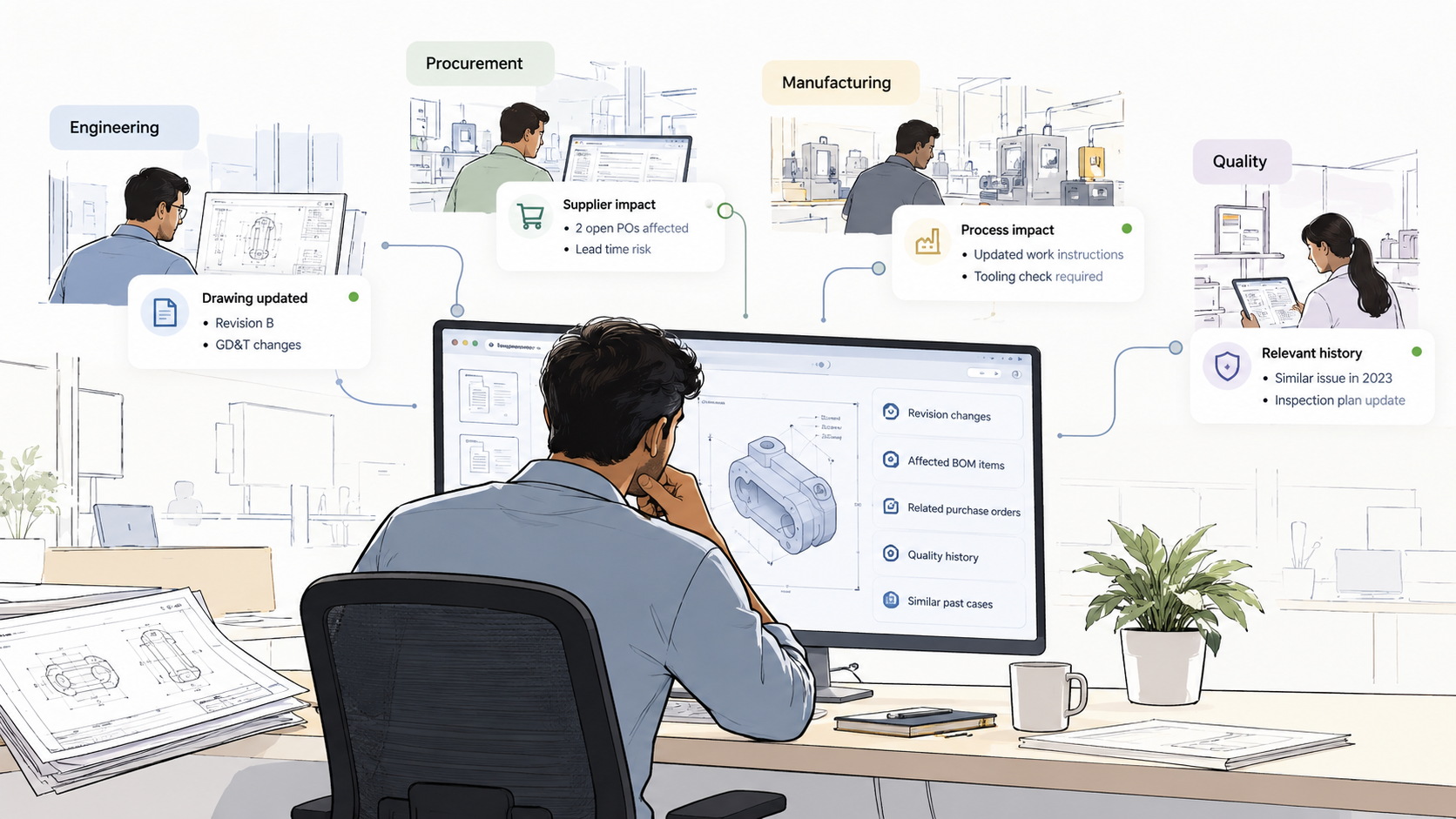
When we started building ADEOS, the problem statement was very specific: Extract Bill of Materials (BOMs) from engineering maintenance manuals. As we worked with more engineering organizations, the problem became larger.
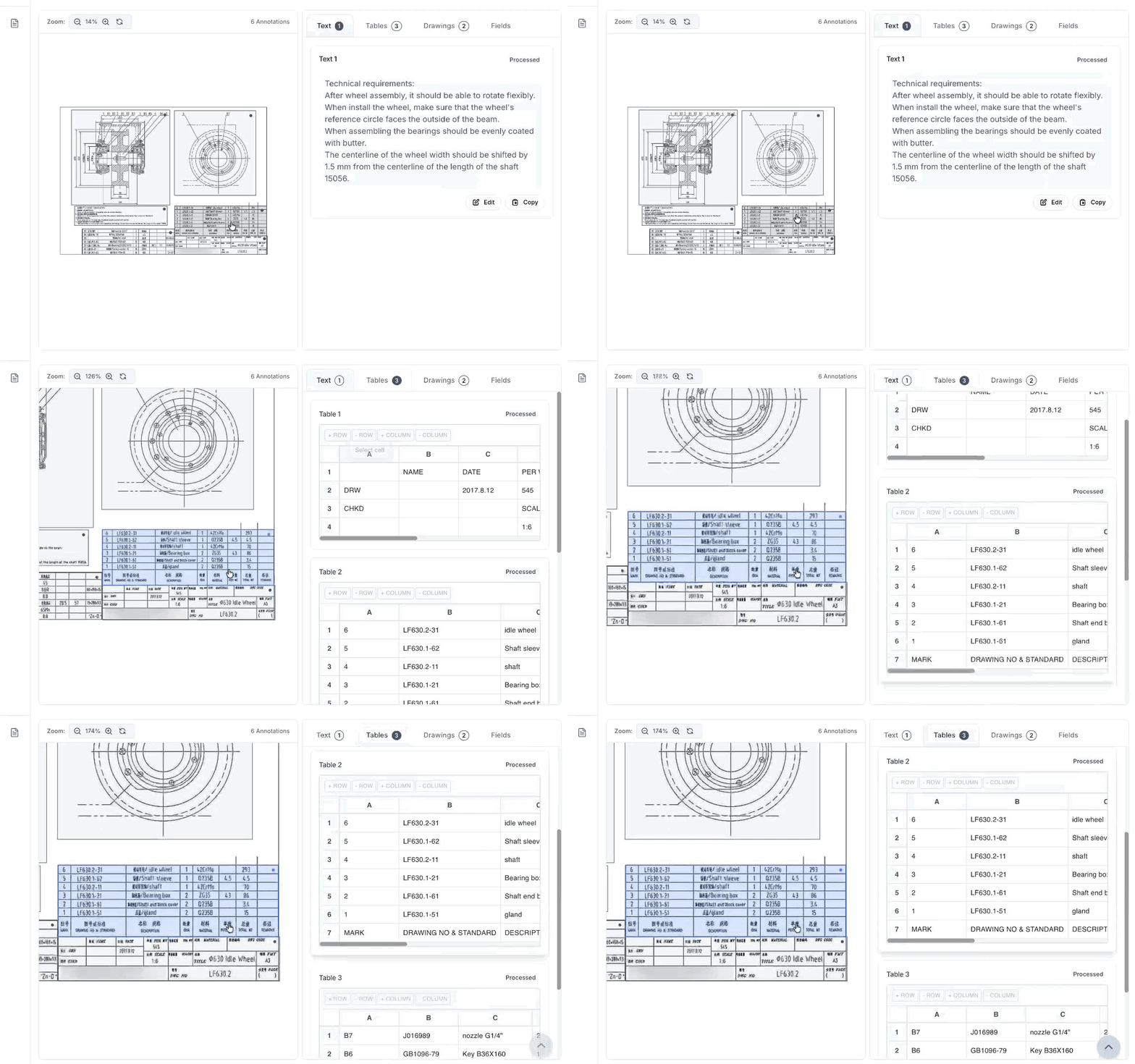
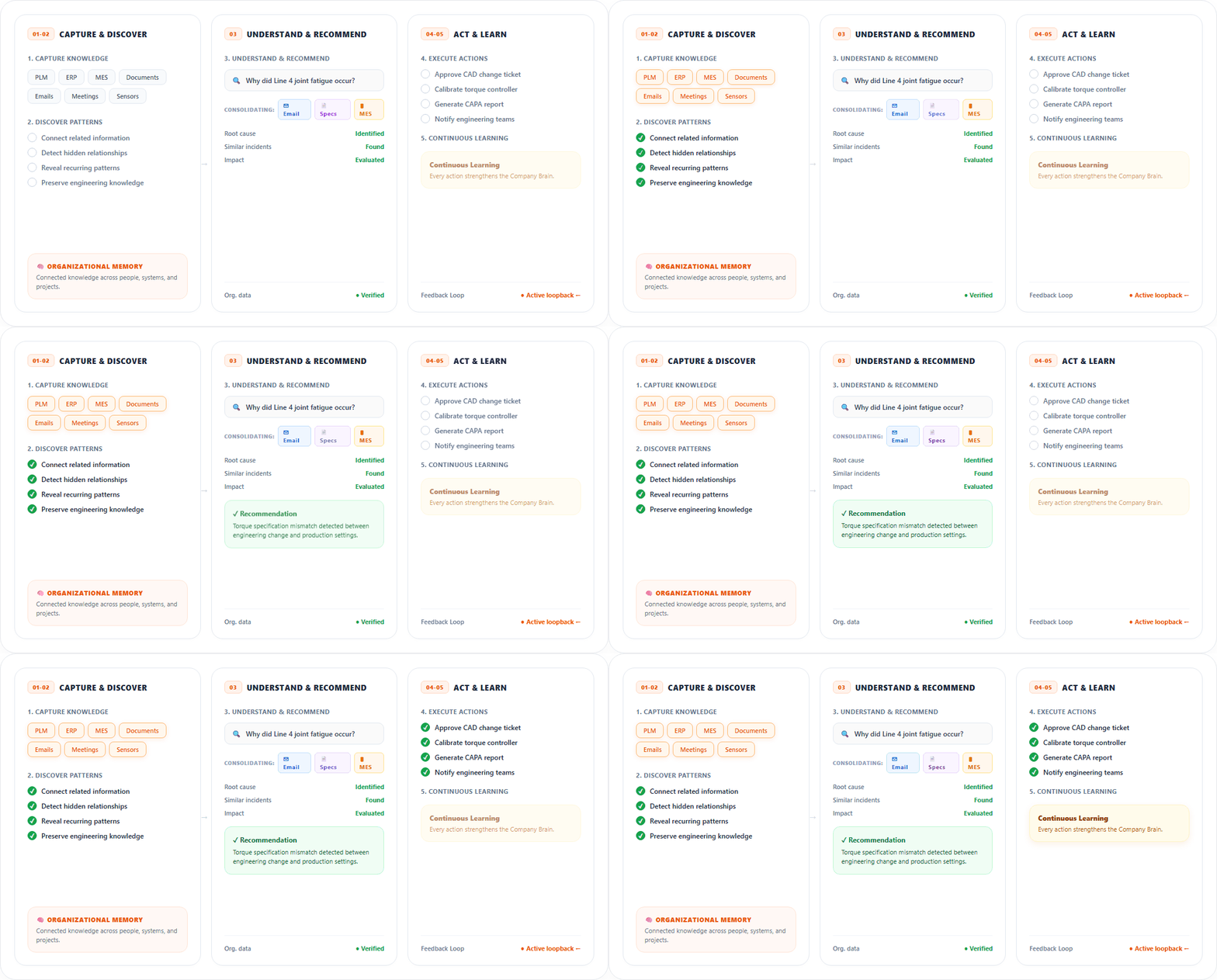
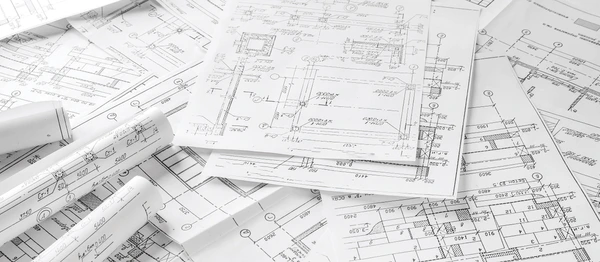
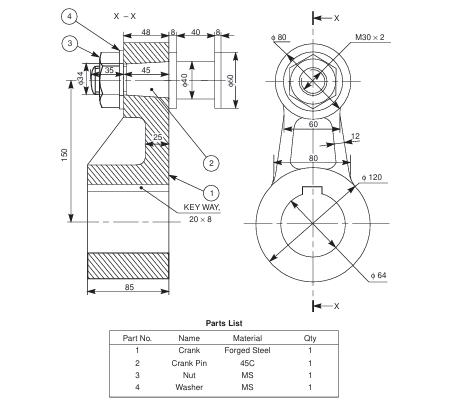
Engineering teams were spending a lot of time reading drawings, extracting that information and feeding that information into other systems. BOMs, dimensions, specifications and other engineering data had to move from documents into the workflows used by procurement, manufacturing and quality. We started by looking at how AI could understand those documents and make the information usable by looking at the connections.
A drawing is connected to a BOM. The BOM is connected to items, suppliers and manufacturing processes. A specification can affect procurement and inspection. A revision can affect work that another team has already started. A quality issue can lead to an engineering change. The information is spread across the systems and workflows that run the organization every day.
We have already spoken about the missing intelligence layer in manufacturing systems, and how ADEOS approaches the document side of the problem. Building that intelligence layer has taught us another part of the problem.
The value of organizational intelligence depends heavily on how quickly useful context reaches the person who needs it.
Engineering information has a latency problem
Most engineering organizations have plenty of information. The problem appears when someone needs to use it.
An engineering manager wants to know why a project is slipping. The answer may involve a drawing revision, a delayed PO, a supplier issue and a quality deviation. Each piece of information may exist in a different system. Someone has to collect the information before the manager can understand what is happening.
An engineer reviewing a drawing may need to know whether a similar change was made on an earlier project. A procurement team may need to know whether a specification has caused problems with a supplier before. A quality team may need to know whether a current issue has appeared in previous revisions.
The information exists. Getting it together takes time. This creates a form of latency inside the organization. The delay is between something happening and the relevant people having enough context to respond to it.
The delay may be a few minutes when someone knows exactly where to look. It may be several hours when information needs to be collected from multiple systems. It may be several days when people need to ask other teams, search old files or reconstruct what happened from email and spreadsheets.
For an engineering organization, this delay has a real cost. Decisions wait. Reviews get postponed. People repeat work. Issues move further downstream before someone has enough information to act.
Assembling the Context
Now consider the same review with the relevant context already assembled. The manager can see the current revision, the changes from the previous revision, the affected items, related procurement activity, previous issues and the actions already taken by the team.
This is where we see low latency intelligence becoming important. A useful intelligence layer should reduce the time between an event and the organization understanding its implications. The shorter that time becomes, the closer decisions can happen to the events that require them.
This matters especially in engineering because many problems become more expensive as they move downstream.
A design issue caught during review is different from the same issue found during manufacturing. A supplier issue found before production is different from one discovered after material has been received. A revision understood before procurement starts is different from one discovered after orders have been placed.
The value of context increases when it arrives early enough to affect the next decision.
Context is created while work happens
A large part of an organization's knowledge is created through everyday work.
- An engineer changes a specification because of a manufacturing problem.
- A quality engineer adds an inspection step after a recurring failure.
- Procurement stops using a supplier after repeated quality issues.
- A project team approves an exception because a customer requirement changed.
These decisions become part of the organization's experience. The problem is that enterprise systems usually record the result of the work. They are designed around transactions, records, documents and workflow states. The reasoning around those events can be much harder to retrieve later.
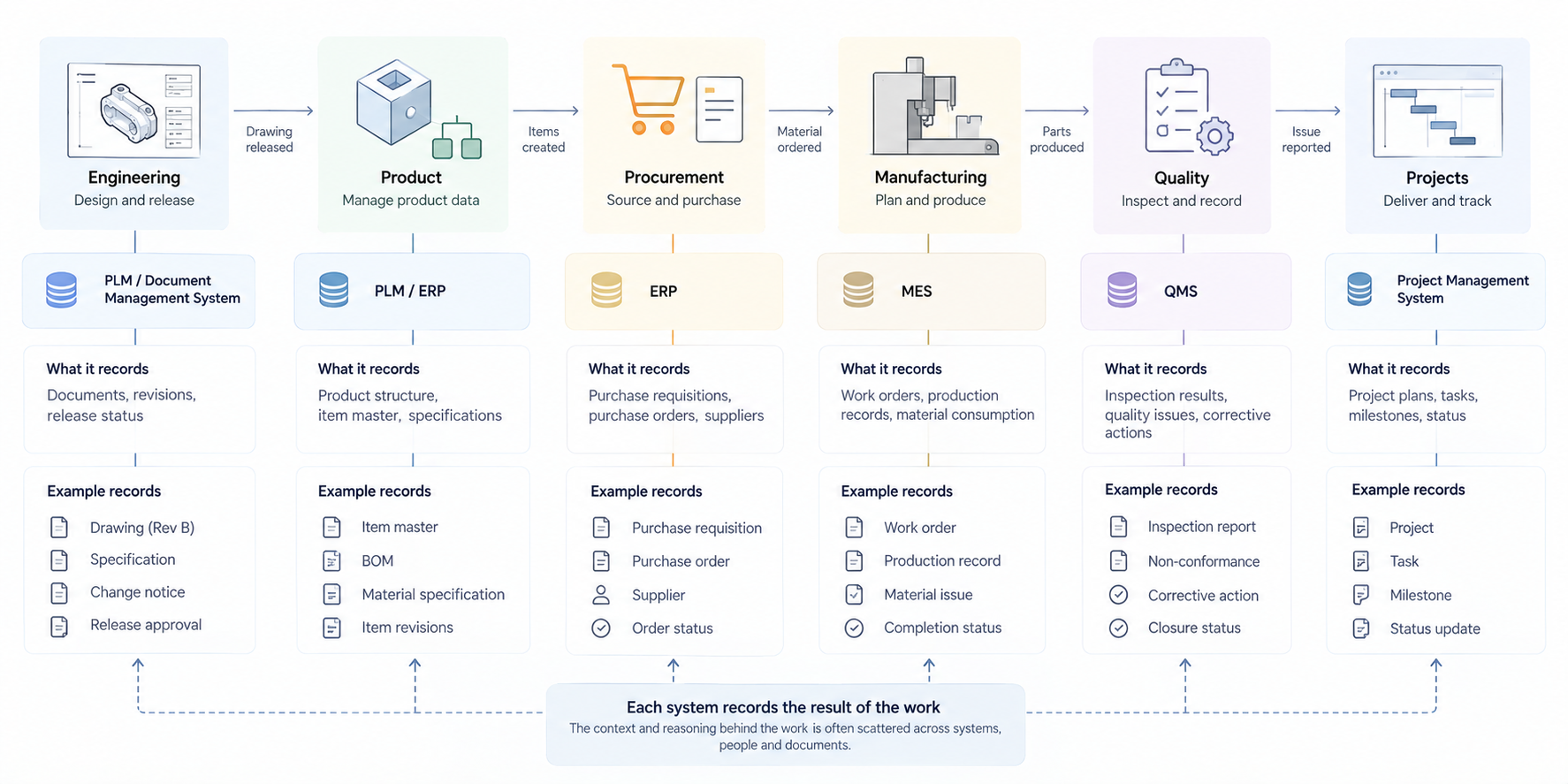 A purchase order tells us that something was purchased. A quality record tells us that a problem was found. A revision tells us that a drawing changed. An approval tells us that someone accepted a decision.
Understanding why these things happened requires connecting them. This is an important part of building organizational intelligence. The system needs to learn from the work that people are already doing. Each revision, decision, exception and outcome adds context that can become useful later.
AI needs access to the organization's working context
LLMs have become very capable at reasoning over information. They can interpret documents, compare revisions, extract structured data and explain technical content.
For an engineering organization, the model also needs access to the context around that information.
If an AI system is reviewing a drawing, the useful context may include the previous revision, the relevant BOM, the product information, applicable specifications, quality history and related project information.
That context cannot live entirely inside the model. It needs to come from the systems where the organization already does its work.
This is why we think about Weaving AI as an engineering problem as much as an AI problem. The work requires connecting models with documents, databases, APIs, workflows and existing business systems. The AI needs to receive the right information at the right point in the workflow and return something that can be used by the people or systems taking the next step.
The quality of the intelligence depends on the quality of those connections.
The best interface may be the workflow itself
Engineering teams already have systems for most of the work they do. They have ERP, PLM, MES, QMS, document management systems and project tools.
Adding another dashboard creates another place for people to check. There are situations where a dashboard is useful. There are many other situations where the information is more useful when it appears as part of the workflow.
- A drawing review can surface relevant previous changes.
- A purchase approval can show related supplier quality history.
- A quality investigation can surface similar issues from previous projects.
- A project review can identify dependencies that have changed since the last review.
- An engineering change can identify affected downstream records before someone approves it.
The intelligence becomes part of the work rather than another task for the team. This is an important direction for Weaving AI. We want intelligence to reach people in the systems and workflows where they already make decisions.
Closing Thoughts
The objective is to give an engineering organization a way to use the information it already creates with much lower latency. The system should understand the relationships between engineering information, business systems, workflows and historical decisions. It should be able to bring relevant context into a decision without requiring someone to manually assemble it first.
For an engineering founder, that could mean getting a clearer picture of a project without waiting for the next review meeting. For an engineering manager, it could mean understanding the impact of a change before it reaches procurement or manufacturing. For an engineering team, it could mean finding the relevant history without asking several people or searching through multiple systems.
An experienced engineer may remember why a particular design decision was made. A quality manager may remember a supplier issue from several years ago. A project manager may know that a particular type of change usually creates problems later in the project.
That knowledge is valuable because it helps people make decisions faster. The challenge is making more of that context available to the organization without requiring the same people to be present every time.
Are you interested in getting better intelligence from your engineering documents and data? Are you looking to optimize data flow between departments? Reach out to us at coffee@coffeeinc.in and we can discuss.