Read with Claude
 Read with ChatGPT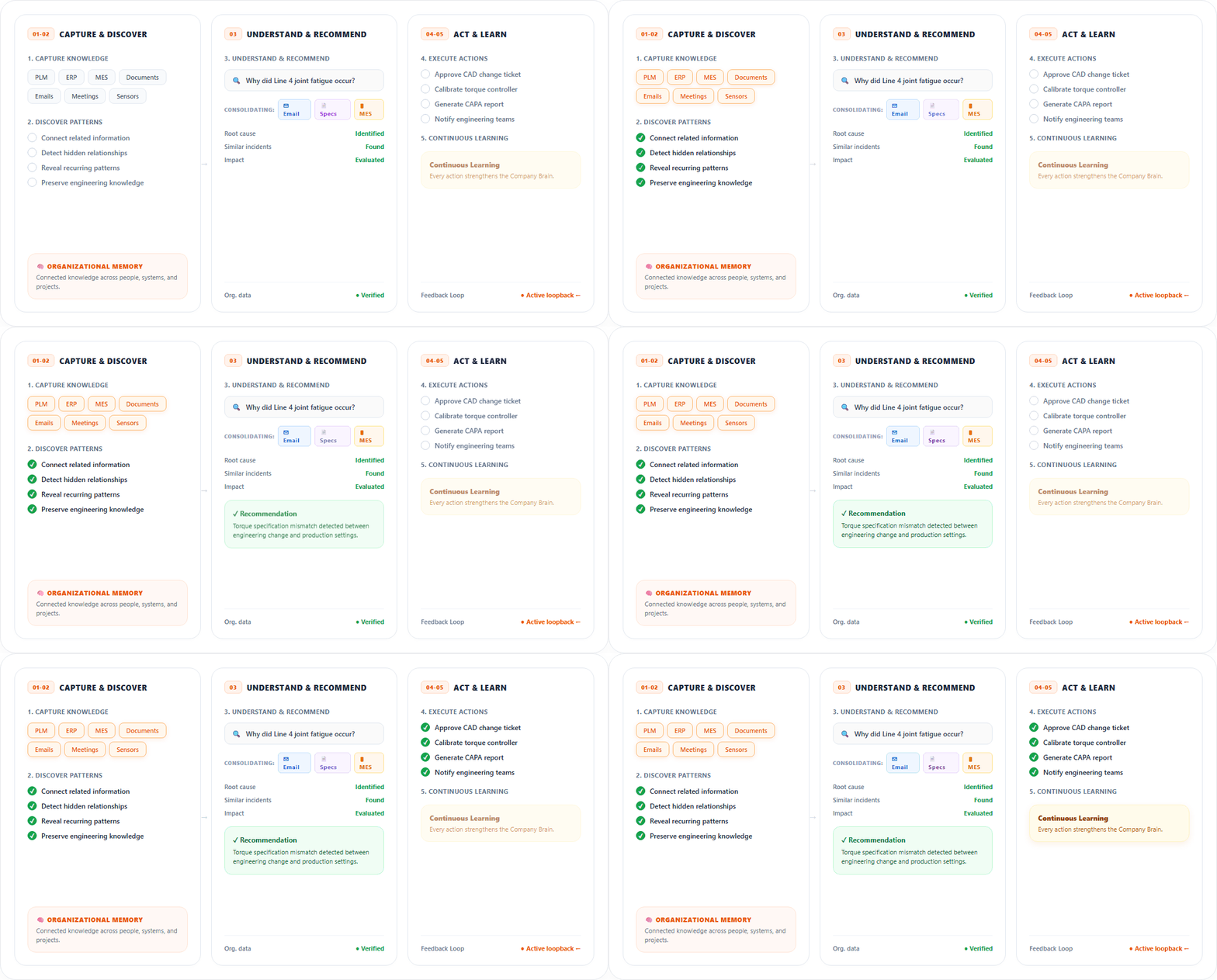
AI agents and copilots are now everywhere. Modern AI models can reason, generate, and analyze at impressive levels, but enterprise results stay inconsistent because models understand engineering in general, not the specific workflows and decision-making practices of individual departments.
This challenge is that without department-specific workflows, decision history, and institutional knowledge, AI reasons from generic knowledge instead of your organization's accumulated experience.
How Expertise Actually Builds
Every department builds expertise over time through the decisions it makes and the work it performs. That expertise evolves through a simple progression:
-
Data - Raw information and decisions.
-
Patterns - Recurring relationships recognized through experience.
-
Knowledge - Judgment built from those patterns.
Engineers naturally develop this judgment through repeated work. They remember why a design was rejected, which suppliers repeatedly introduced quality issues, how previous investigations were resolved, and which engineering decisions eventually became standard practice.
Where Knowledge Gets Lost
Organizations rarely preserve this judgment in a form AI can use. Most of it remains scattered across documents, emails, meetings, enterprise systems, and individual experience.
As a result, AI adoption exposes this directly. An agent can only reason within the context it's given. When departmental knowledge stays scattered across documents, emails, team drives, and individual memory, AI amplifies that fragmentation instead of fixing it.
Why Knowledge Needs to Persist
Organizations operate through relationships between departments. Every department follows its own unique workflows while continuously creating context for the teams that depend on it. AI requires this knowledge to be structured, accessible, and persistent across departmental workflows
Before organizations can build intelligent systems, individual departments need to become systems that remember. That requires a dedicated intelligence layer that preserves knowledge as it is created and makes it continuously available to both engineers and AI.
This marks a fundamental shift in enterprise software from systems that document work to systems that understand department-level work.
The Organization Brain at the Department Level
The Organization Brain is an engineering-first intelligence layer that sits above existing enterprise systems. It continuously captures information generated through departmental work, connects it into organizational context, understands how engineering decisions are made, and delivers intelligence back into everyday operations.
To build a connected understanding of how information moves across teams, the platform continuously develops an understanding of the department's engineering knowledge and its operational practices of every department.
-
What the department works with includes the drawings, specifications, requirements, records, historical decisions, and other engineering information that teams rely on throughout their work.
-
How the department works encompasses the reviews, approvals, engineering practices, workflows, and decision-making patterns that govern how work is executed and progresses across the department.
Together, these create a continuously evolving operational memory that captures both the department's engineering context and its way of working, providing the foundation for reliable reasoning, contextual recommendations, and automation across departmental workflows.
What the Organization Brain Delivers
An Organization Brain combines two complementary systems:
-
A System of Intelligence that continuously builds a semantic understanding of the department’s engineering processes, decisions, relationships, and institutional knowledge.
-
A System of Agency that enables governed AI agents to reason, recommend, and act using that department-specific intelligence rather than isolated documents.
Together, they transform enterprise knowledge from a passive repository into an active, department-level operational capability.
Over time, this enables organizations to:
-
Connect fragmented knowledge into unified departmental memory across structured and unstructured data.
-
Continuously improve knowledge quality by identifying outdated, duplicate, or conflicting information as work happens inside department workflows.
-
Capture institutional judgment by preserving not just raw documents, but the reasoning behind department-specific engineering decisions.
-
Deliver intelligence inside existing departmental workflows surfacing the right context during reviews, investigations, design changes, and production decisions.
-
Create a learning organization where every project, incident, and decision strengthens the intelligence available for future work within that department.
Organizational knowledge can evolve continuously alongside each department's workflows over time. Rather than acting as another repository, the Organization Brain serves as an operational intelligence layer that captures, connects, and continuously refines organizational knowledge as work happens.
Conclusion
AI readiness is no longer just about deploying more AI agents or copilots. It’s about building the department-level institutional intelligence that powers them.
As engineering workflows continue to evolve, organizations with an Organization Brain will establish a unified layer of intelligence and agency grounded in the company's collective knowledge, operational context, and decision history, enabling every department to reason and act from the same shared understanding.