Read with Claude
 Read with ChatGPT
In many founder-led companies, the founder is still involved in almost everything. A customer asks for something, the founder answers. A quote needs to go out, the founder reviews it. A vendor needs approval, the founder decides. A delivery is slipping, the founder steps in.
It works until it does not.
As the company grows, the founder slowly becomes the place where work waits. The obvious answer is to delegate, but that creates another question:
What should the founder delegate first?
The answer is usually already hiding in the work.
The founder carries the context
Founders often know things that are not written anywhere. They know why one customer gets a different price, which vendor can be trusted, why a process works differently for one client, and which decisions need their attention.
The company runs on this context, but much of it lives in the founder's head. That is why hiring someone does not always solve the problem. The new person now needs the same context, so the founder still has to explain, review and correct the work.
The problem is not simply too much work. It is too many decisions depending on one person.
The work already contains the answers
The company is constantly producing evidence of how it operates.
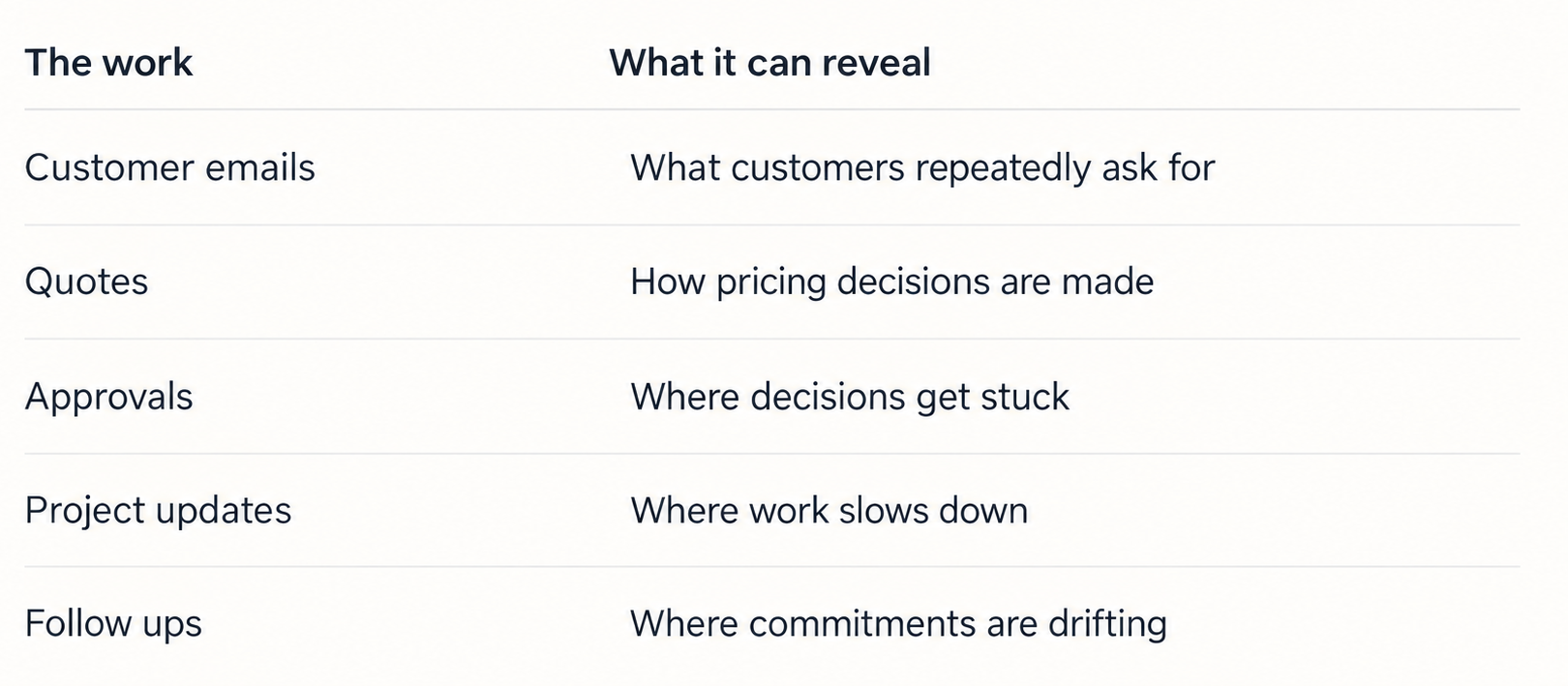 Look at enough of this work together and patterns start to appear.
- Which decisions keep coming back?
- Where does the founder spend most of their time?
- What keeps getting stuck?
- What could someone else own?
This is similar to the idea behind building an intelligence layer for organisations. The useful information is often already there. The challenge is making the relationships between those pieces visible.
What should leave the founder's desk?
Not everything the founder does needs to be delegated to another person. Different kinds of work need different solutions.
-
Some work needs an owner.
-
Some work needs a process.
-
Some decisions need a rule.
-
Some work can be automated.
-
Some work should probably disappear.
The pattern matters more than the job title.
- If the founder approves the same request in almost the same way every time, there may be a rule waiting to be written.
- If they spend hours collecting information before making a decision, the process may be the problem.
- If the same customer issue keeps reaching them, ownership may be missing.
- If something takes hours but contributes very little to the business, perhaps it should not be happening at all.
This is where delegation becomes more useful. You are not simply moving work from one person to another. You are figuring out what the company should do differently.
The dashboard is not the point
A founder who is already running sales, delivery, finance and operations is probably not looking for another dashboard to check every Friday. They need useful information when a decision needs to be made.
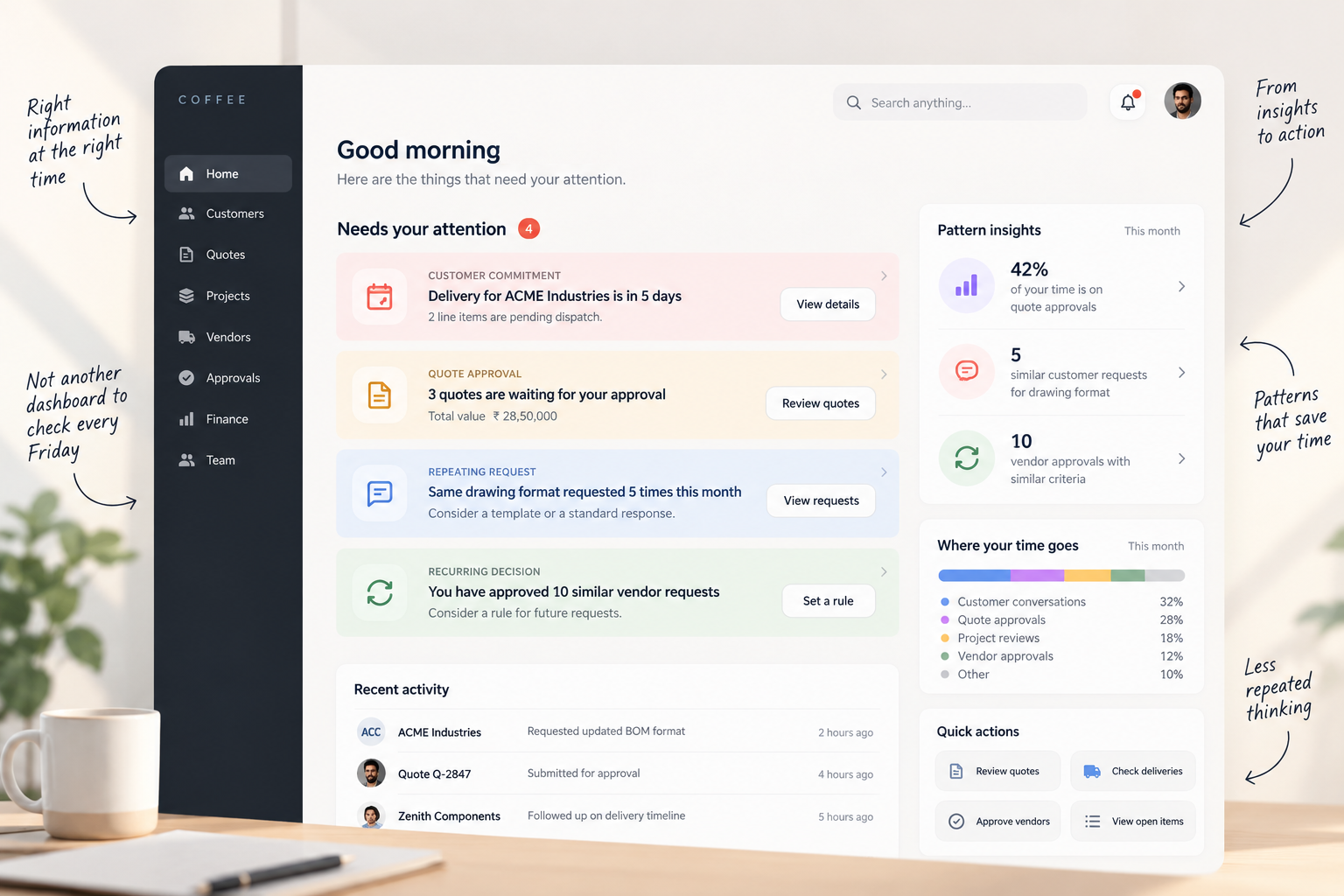 For example:
-
A customer commitment is approaching.
-
A quote has been waiting for approval.
-
The same request has appeared five times this month.
-
A decision has been made the same way ten times.
These moments tell the founder something useful about the business because they connect information to action.
The goal is not more information. It is less repeated thinking.
Closing Thoughts
Eventually, the founder's role has to change. Not from being involved to being uninvolved, but from answering every question to deciding which questions should still reach them.
The work already happening in the company can show the way. It can reveal what takes the founder's time, what keeps coming back, what can become a process, what can be handed over and what should stop happening.
That is the real transition.
The company does not become less founder led because the founder steps away from everything. It becomes less founder dependent because the business starts learning from the decisions the founder has already been making.