Read with Claude
 Read with ChatGPT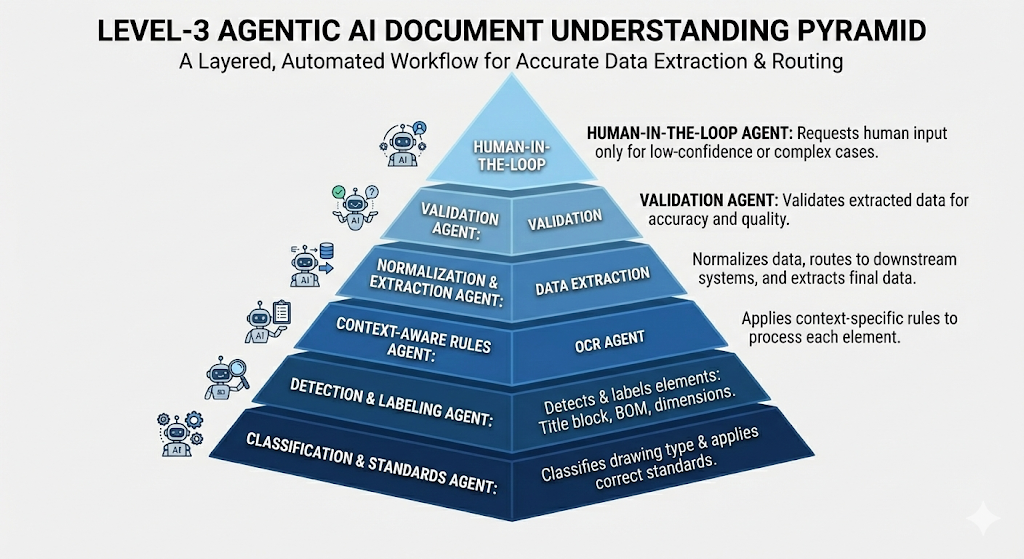
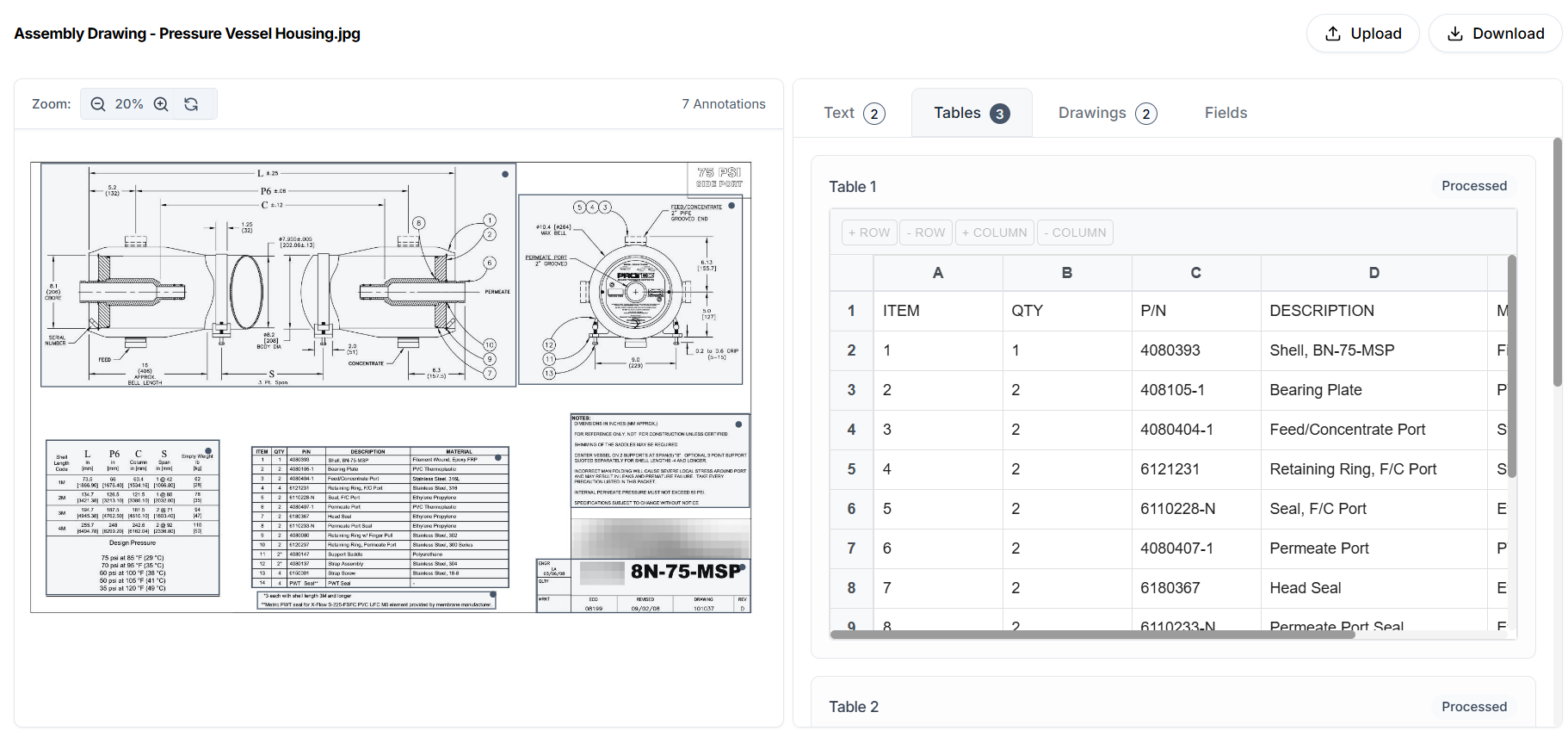
When it comes to reading Engineering Drawings, there is no one better at it than an experienced engineer. They read drawings easily by switching contexts: they know where to look for data, which annotations matter downstream, and how one element constrains another. One of the major factors then becomes the amount of time it takes to read each drawing.
This is where Level 3 Agentic AI comes in.
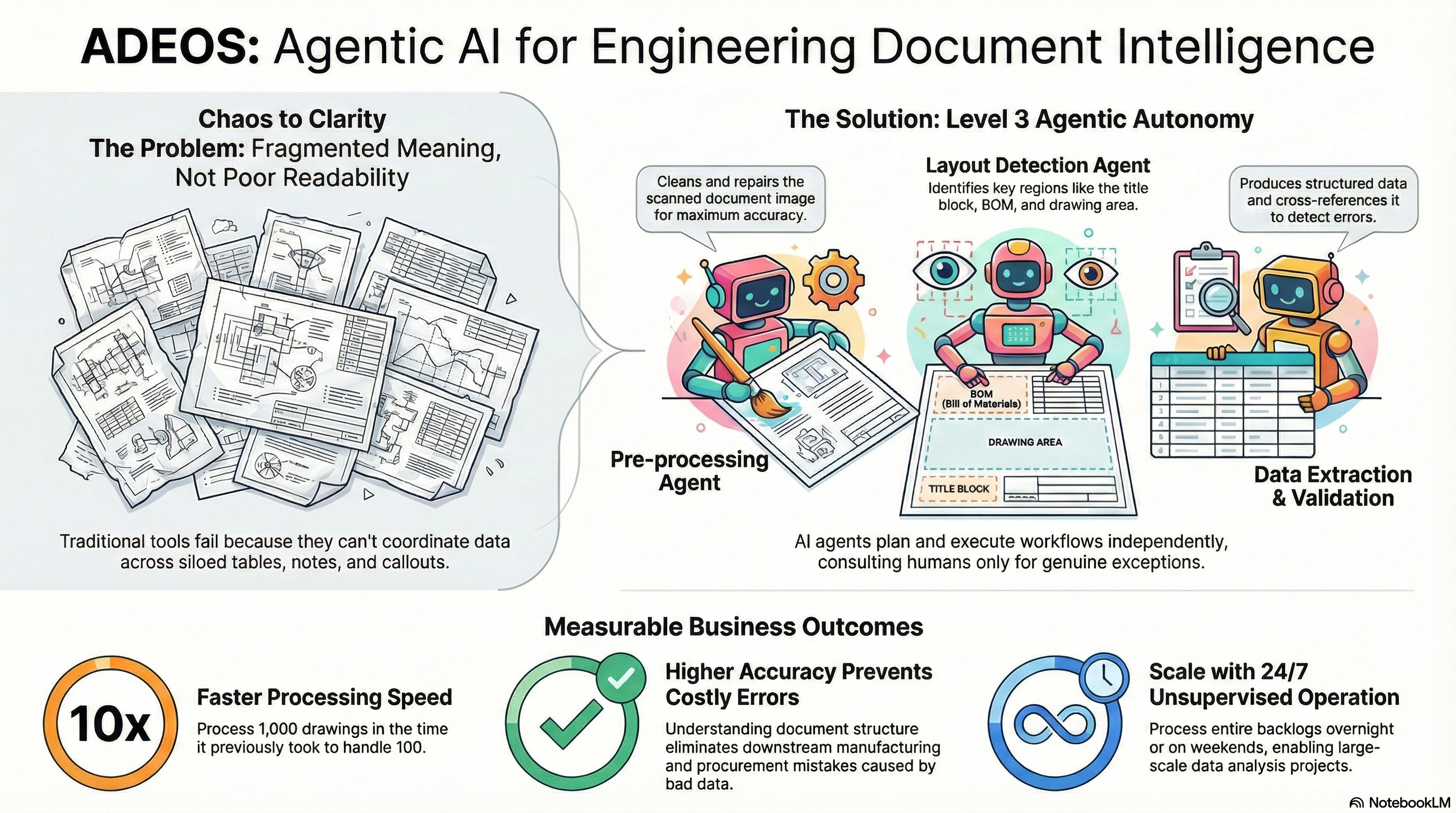
Level-3 agentic AI treats document understanding as a layered workflow: first it classifies the drawing and picks the right standards, then it detects and labels elements (title block, BOM, dimensions), applies context-aware rules to handle each element, normalizes, routes and extracts the data to downstream systems.
Agentic AI in Engineering Document Intelligence: What Level of Autonomy should Document AI have?
The complexity is taken away from users the agent plans, validates, and only asks for human input on cases like low-confidence score after extraction so organizations get accurate, actionable data from multiple PDFs with minimal supervision.
What Level 3 Autonomy Means in Practice
ADEOS operates at Level 3 autonomy. The agents take initiative in planning and execution, but they consult users when uncertainty exceeds acceptable thresholds.
The agents handle the vast majority of extraction work without user input:
- Detect and classify document quality issues
- Apply corrections to improve image quality
- Identify and mark sections with bounding boxes
- Resolve overlapping detections using priority rules
- Extract structured data from tables and title blocks
- Parse dimension callouts and geometric tolerances
- Cross-reference part numbers across sections
- Format extracted data for export
This independence enables scale. One user can oversee the processing of hundreds or thousands of documents because the agents do not require approval or guidance for standard extraction tasks.
When the Agents Consult Users
The agents seek user input in specific situations:
- During initial system setup when learning document templates
- When a new template appears that does not match learned patterns
- When confidence scores fall below the threshold for reliable extraction
- When conflicting information appears that requires domain knowledge to resolve
- When validation rules detect potential errors that need human review
This consultation is not constant. It happens during training periods and when genuine exceptions occur, not during routine processing of known document types.
What Users Do Not Need to Do
Users do not need to:
- Review every extracted field for accuracy
- Make decisions about overlap resolution
- Classify anomaly types
- Sequence extraction steps
- Configure computer vision parameters
- Understand model internals
The agents handle these details. The user provides domain knowledge about what correct extraction looks like for their specific documents and validates results at key checkpoints, but the agents own the execution.
What This Delivers for Engineering Teams
Level 3 autonomy produces specific, measurable outcomes starting with saving the engineer’s time.
Speed: Faster Processing
A drawing that takes a lot of time to process manually takes a few minutes with Adeos. The agents handle image preprocessing, section detection, overlap resolution, and data extraction without waiting for user input at each step. Users only engage when exceptions occur.
At scale, this means processing 1,000 drawings in the time it previously took to handle 100.
Accuracy
The agents achieve higher accuracy on data extraction because they understand document structure, not just text recognition. They know that a row in a bill of materials table contains a part number, description, quantity, and material specification in specific columns. They know that a title block contains revision history in a predictable location. They know that overlapping bounding boxes need resolution before extraction begins.
Traditional OCR achieves 60 to 70 percent accuracy on engineering drawings because it treats structure as noise rather than signal.
Cost Reduction
Processing costs drop because fewer person-hours are required per document and because extraction errors that cause rework are eliminated. Teams that previously spent 100 hours per week on manual data entry spend fewer hours per week with Adeos.
The cost reduction compounds when you consider downstream errors prevented. Manufacturing teams working from incorrect dimensions waste materials and machining time. Procurement teams ordering wrong materials create inventory problems. Adeos prevents these errors by extracting data correctly the first time.
Scale: 24/7 Processing Availability
Adeos processes documents continuously without human presence. Batches uploaded overnight complete by morning. Large backlogs process over weekends. The agents do not require supervision during routine processing, only periodic validation that results meet quality standards.
This availability enables workflows that were not previously possible. Engineering teams can now extract data from entire drawing archives, cross-reference information across thousands of documents, and build searchable databases of technical specifications.
Conclusion
ADEOS demonstrates what agentic AI looks like when applied to a real business problem with clear requirements: extract structured data from complex engineering drawings at scale with high accuracy and low error rates.
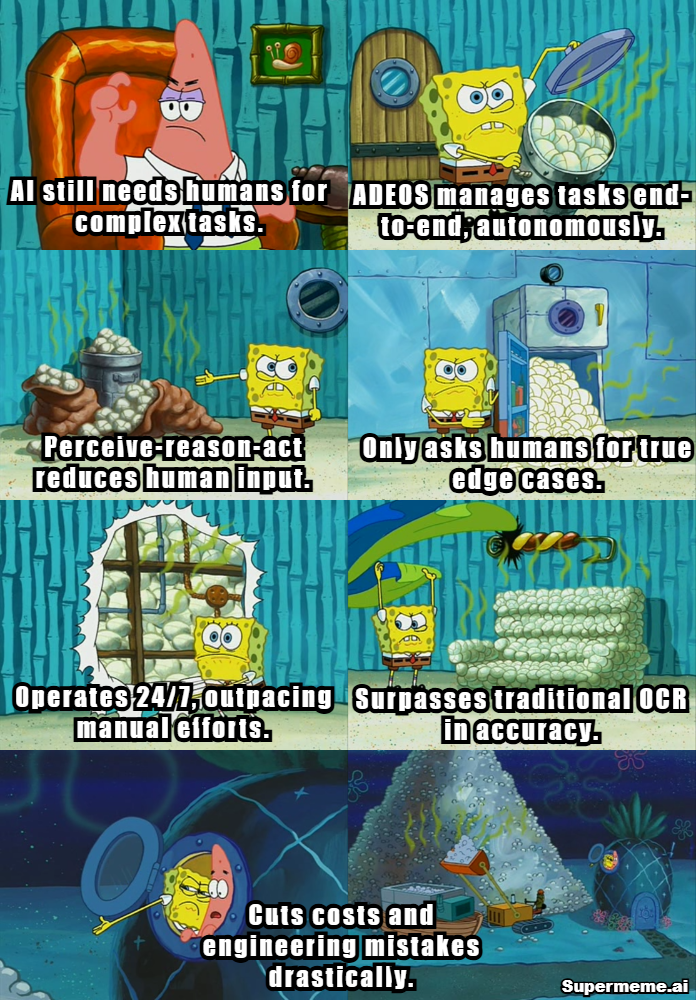
The solution is not full autonomy. It is the right level of autonomy for the problem.
The agents, working in sequence, deliver the speed necessary to process thousands of documents while maintaining the accuracy necessary for engineering data. Each agent operates at Level 3 autonomy: taking initiative to handle its domain independently while consulting users when uncertainty exceeds acceptable thresholds.
The result is measurable: faster processing, higher extraction accuracy, cost reduction, and 24/7 availability.
If you are interested in Adeos, the Agentic Document Extraction tool that can be used to extract key information from engineering drawings, reach out to us at coffee@coffeeinc.in. We can deploy these agents for your use-cases.