Read with Claude
 Read with ChatGPT

A tutor reviews a student's mathematics worksheet and notices a recurring error in how the student expands brackets. The tutor corrects it, explains the underlying concept and asks the student to pay attention to it in future exercises.
A few weeks later, the same mistake appears in another worksheet. The tutor recognises the error and provides feedback again. But how often has this happened? Has the student made the same mistake in other topics? Has the earlier feedback helped? Is the problem limited to one concept or does it point to a gap in foundational understanding?
These questions require looking beyond the most recent assessment.
Students complete chapter tests, unit tests, practice worksheets and model exams throughout the academic year. Over a term, a student may submit 30 or more worksheets. Each one gives the tutor information about the student's understanding, approach to problems and ability to apply concepts.
Tutors already use this information to correct mistakes and guide students. The challenge is connecting these individual evaluations to build a continuous picture of how a student is progressing.
Evaluating Individual Worksheets Is Only Part of the Process
A student solves several worksheets every week, adding up to 30+ worksheets over a term.
The tutor reviews each one, makes the corrections, and shares the results by the end of the week. At the same time, the tutor is teaching classes, so by the time one review is complete, the next one is already waiting.
In an International Baccalaureate (IB) institutions, each worksheet is assessed against four criteria, A to D:
-
Knowing and understanding
-
Investigating patterns
-
Communicating
-
Applying mathematics in real-life contexts
IB looks at how well a student understands and applies a concept, not just whether they follow fixed steps. The tutor reviews the worksheet, identifies these issues and provides corrections. This process is repeated for every assessment.
The problem, therefore, is not a lack of feedback or an inability to recognise mistakes. It is the additional effort required to maintain and connect assessment information over time.
When a tutor is handling multiple students, classes and weekly assessments, comparing every new worksheet with a student's earlier work becomes another task competing for their time.
For example, a student who misunderstands how negative signs operate in basic expressions will continue repeating that exact error whenever a minus sign appears before a bracket, across entirely different units. The error first appears in basic expressions. Later, it shows up while expanding brackets and simplifying equations. Eventually, it affects the student's performance in more advanced topics.
The tutor may have corrected the error at each stage. But connecting these occurrences can reveal that the student has not fully understood a foundational concept. It is easy to miss out on when the topics pile up and progress keeps moving to the next worksheet.
A Term of Worksheets Holds the Pattern
Everything the tutor needed to understand the problem was already in the worksheets. What was missing was a way to look at them together.
Over a term, one student submits multiple worksheets. Each one shows how she worked through a set of problems:
-
The topic
-
The steps she followed
-
The criteria used to assess each answer
When assessments are considered together, tutors can examine:
-
When a particular mistake first appeared.
-
How frequently it occurs across subsequent worksheets.
-
Which topics are affected by the same underlying difficulty.
-
Whether feedback from earlier assessments has helped.
-
Which assessment criteria consistently need attention.
This is not about discovering mistakes that tutors cannot see. It is about making it easier to understand the history behind those mistakes.
From Individual Evaluations to Continuous Student Records
A tutor can spend a weekend going through one child's worksheets to find these patterns.
But a tutor would need to do the same for every student, every week. That is not practical alongside regular teaching and evaluation.
When every worksheet is reviewed against the same criteria and its results are stored in one record for each student, repeated mistakes become easier to spot across topics and criteria without adding this extra work.
-
For students, feedback can go beyond identifying incorrect answers. It can help them understand which concepts and steps need more attention before their next assessment.
-
For tutors, previous evaluations become easier to refer to when assessing a student's latest work. They can spend less time reconstructing assessment history and more time addressing learning gaps.
-
For parents, progress can be explained through more than overall marks. They can understand what their child is struggling with, what support is being provided and whether there is improvement.
-
For institutions, consolidated assessment information provides a better basis for tracking student progress, identifying common learning difficulties and communicating outcomes to parents.
How the Worksheet Evaluator Helps Identify Recurring Mistakes
The Worksheet Evaluator brings worksheet assessment into a consistent process.
Tutors and institutions upload student answer scripts along with the curriculum board (IGCSE, ISC, IB, CBSE, State Board, Singapore MOE and others) and grade. The system generates an evaluation report for each worksheet.
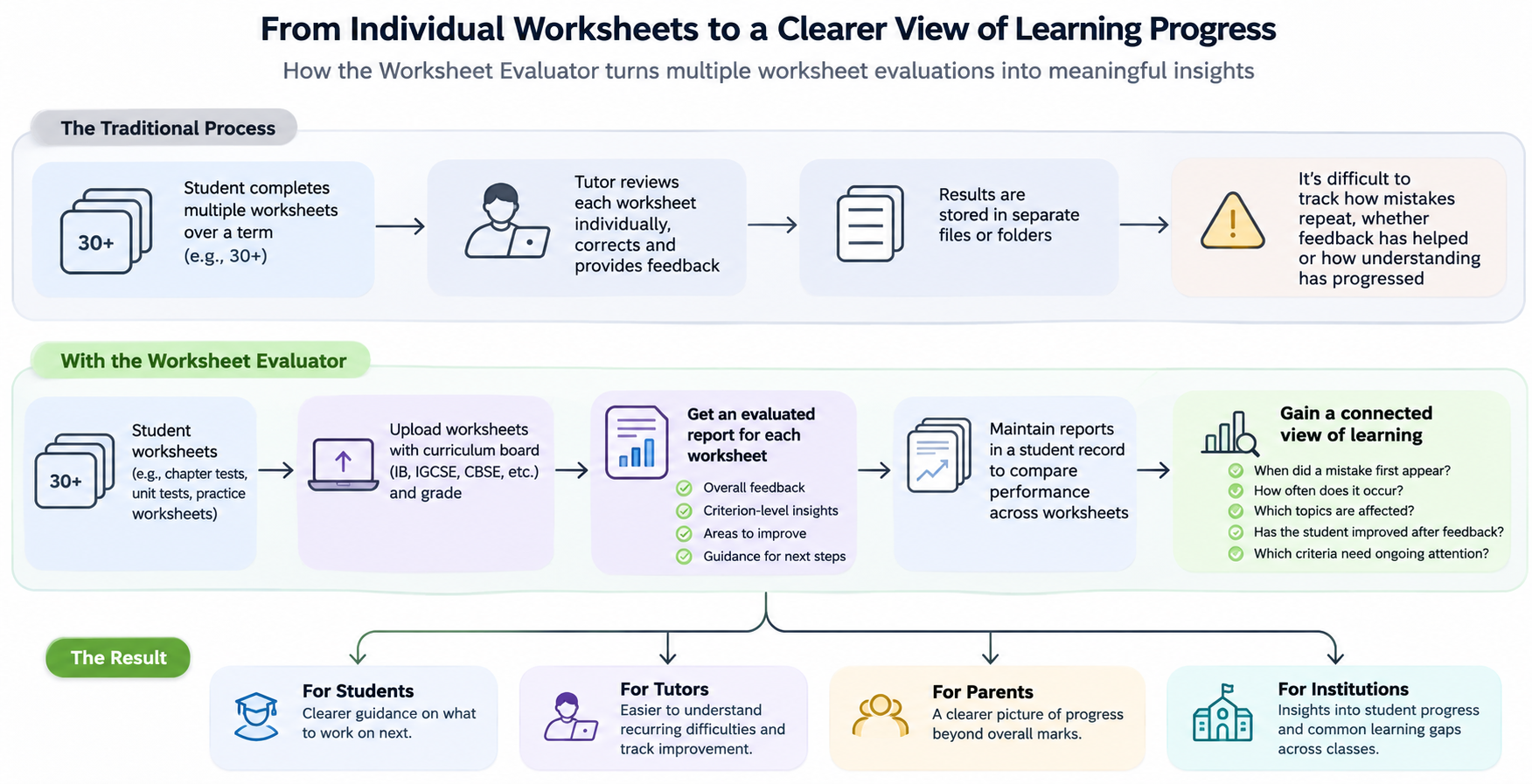 Each report includes:
-
Overall feedback on the student's performance.
-
Criterion-level assessment and insights.
-
Areas where the student needs improvement.
-
Guidance on how to improve answers in future assessments.
These reports provide structured information that can be maintained against each student's assessment history. When considered together, they create a basis for understanding how a student's performance changes across worksheets, which concepts need more attention and whether earlier feedback is translating into improvement.
The objective is to make the information already present in those worksheets easier to organise, compare and use.
Conclusion
A tutor can correct a mistake on a worksheet. They can also recognise when a student repeats it. But understanding how that mistake affects learning across an entire term requires connecting more than one assessment.
30 worksheets are not just 30 evaluation exercises. Together, they form a record of a student's learning journey. Making that record accessible helps tutors understand progress beyond individual marks, gives parents a clearer view of their child's development and helps institutions make better use of the assessment information they already collect.
If your institution evaluates multiple student worksheets and wants to organise assessment records, understand student progress and make better use of evaluation data, reach out to us at Coffee Inc. (coffee@coffeeinc.in) Let's explore how the Worksheet Evaluator can help.