Read with Claude
 Read with ChatGPT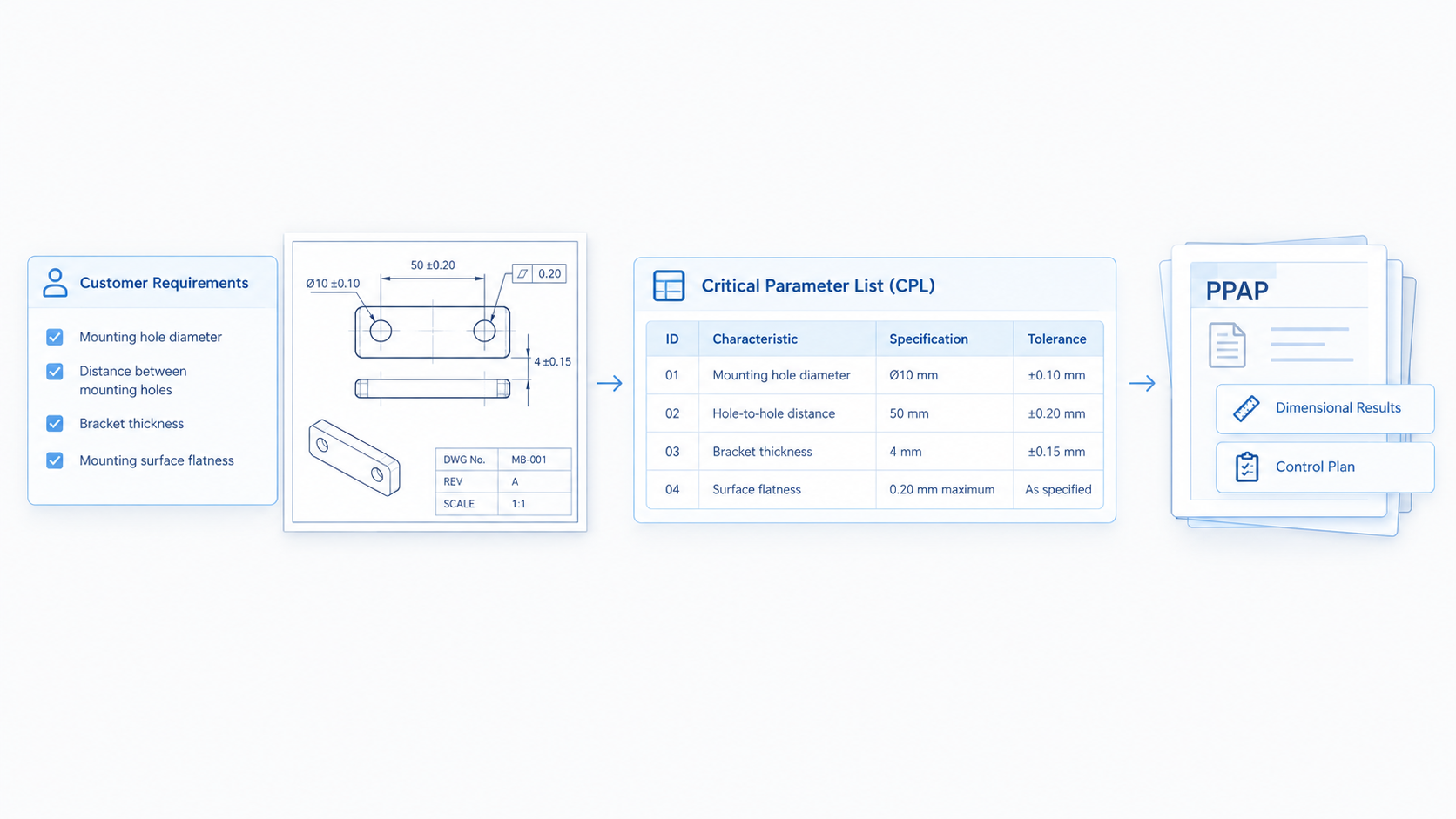
In automotive manufacturing, PPAP preparation requires accurate identification of customer-required characteristics and precise capture of their design specifications. Quality teams must convert these inputs into structured data ready for dimensional results, control plans, and related documentation.
When the customer provides the list of required characteristics, the corresponding design specifications are extracted from the engineering drawing and organized into a controlled Critical Parameter List (CPL). The result is a traceable, revision-aware list that supports consistent PPAP documentation.
1. Customer-provided requirements and the engineering drawing
For a steel mounting bracket used to attach a component to the vehicle chassis, the customer supplies the characteristics that must appear in the dimensional inspection report:
- Mounting hole diameter
- Distance between mounting holes
- Bracket thickness
- Mounting surface flatness
The engineering drawing supplies the design data: dimensions, tolerances, GD&T, and notes. The customer list defines the required characteristics; the drawing provides the matching specifications.
2. Structured Critical Parameter List
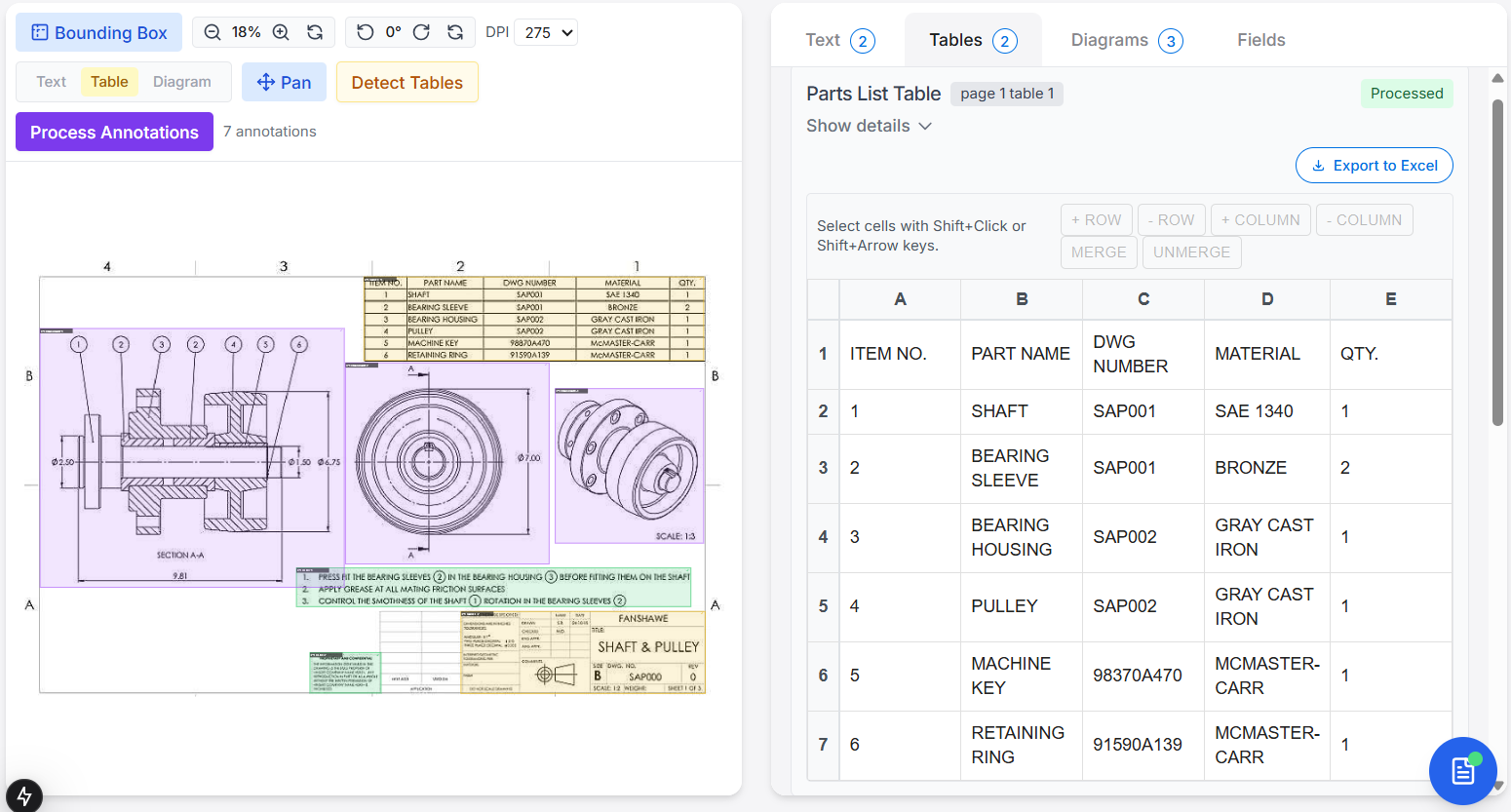
ADEOS processes the drawing against the customer-provided list, extracts the matching design data and organizes it into a controlled CPL:
| ID | Characteristic | Specification | Tolerance |
|---|---|---|---|
| 01 | Mounting hole diameter | Ø10 mm | ±0.10 mm |
| 02 | Hole-to-hole distance | 50 mm | ±0.20 mm |
| 03 | Bracket thickness | 4 mm | ±0.15 mm |
| 04 | Surface flatness | 0.20 mm maximum | As specified |
Each record retains full traceability with drawing number, revision, source reference, and any customer classification. The CPL contains only the required characteristics and their design specifications. Actual inspection measurements are collected separately during dimensional inspection.
3. Integration into the PPAP workflow
A structured CPL eliminates repetitive manual transcription. Quality engineers begin with extracted records rather than locating each characteristic on the drawing and copying its specification by hand.
Outcomes include:
- Reduced transcription errors
- Consistent alignment between customer requirements and inspection documentation
- Complete traceability to drawing number and revision
- Reusable structured data across dimensional results, control plans, and related processes
- Faster impact assessment when specifications change
Engineering oversight remains essential. The structured list removes repetitive preparation work so teams can concentrate on verification, interpretation, and disposition.
4. Handling drawing revisions
When the hole-to-hole distance moves from 50 mm to 52 mm in revision B, ADEOS re-processes the updated drawing against the same customer-provided list. It extracts the new specification, flags the change and updates the CPL with the revised nominal, tolerance and drawing revision.
Validation is mandatory before release into production or customer submission packages. Outdated specifications are prevented from carrying forward.
Conclusion
ADEOS helps manufacturing organizations turn engineering drawings into structured, traceable data that quality teams can use across PPAP and downstream workflows.
By reducing manual data entry and maintaining links to source drawings and revisions, organizations can improve documentation consistency, reduce transcription errors, and respond to engineering changes with greater efficiency.
The result is less repetitive preparation for quality teams and a more reliable foundation for manufacturing quality processes.