Read with Claude
 Read with ChatGPT
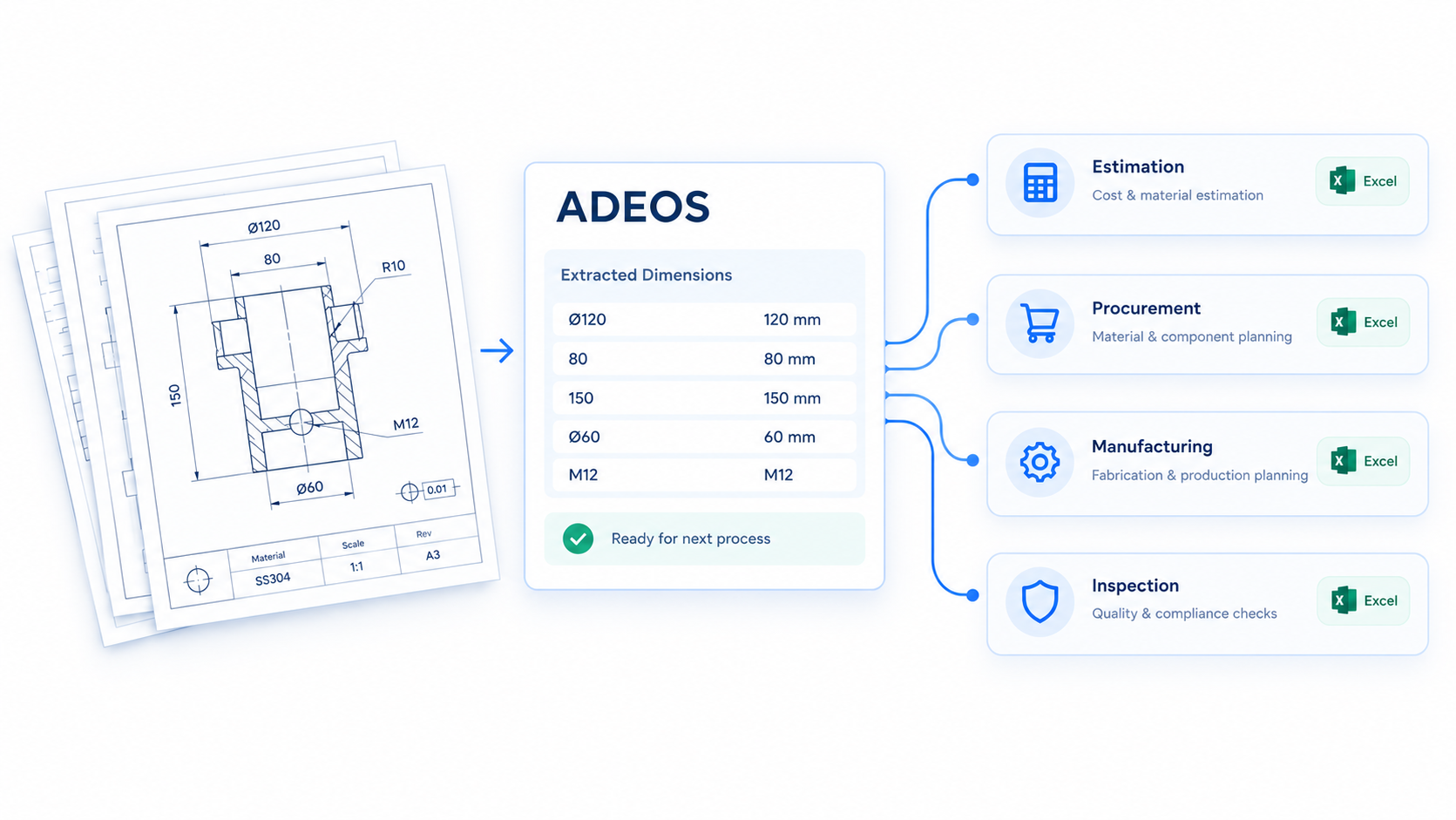
An engineering drawing rarely serves just one purpose. The same drawing may be used by procurement to identify materials, by welding engineers to estimate consumables, by planning teams to calculate workloads and by estimation teams to work out fabrication costs.
Each department reads the drawing from a different perspective. The information they need may overlap, but the way they use it is different. Engineers open the same drawings, identify the relevant details and enter them into their own spreadsheets or business systems. Another department may repeat much of the same exercise, extracting a different set of values from the same document.
When this happens across large drawing sets, the effort adds up. Drawing revisions add another layer of work, as teams must revisit their records and check whether the changes affect their calculations or requirements.
The problem is not a lack of information in engineering drawings. It is the effort involved in making that information available to different departments.
Same drawings, different requirements
Engineering drawings contain dimensions, material specifications, component details, weld information, and other technical data. But no single department needs all of it.
For example:
-
Procurement needs component details and material grades to identify purchase requirements.
-
Welding engineering needs weld dimensions, joint details, and other relevant parameters to estimate welding material consumption.
-
Planning needs dimensions, quantities, and work-related details to estimate the work involved and plan operations.
-
Estimation needs material specifications and dimensions to calculate raw material and fabrication costs.
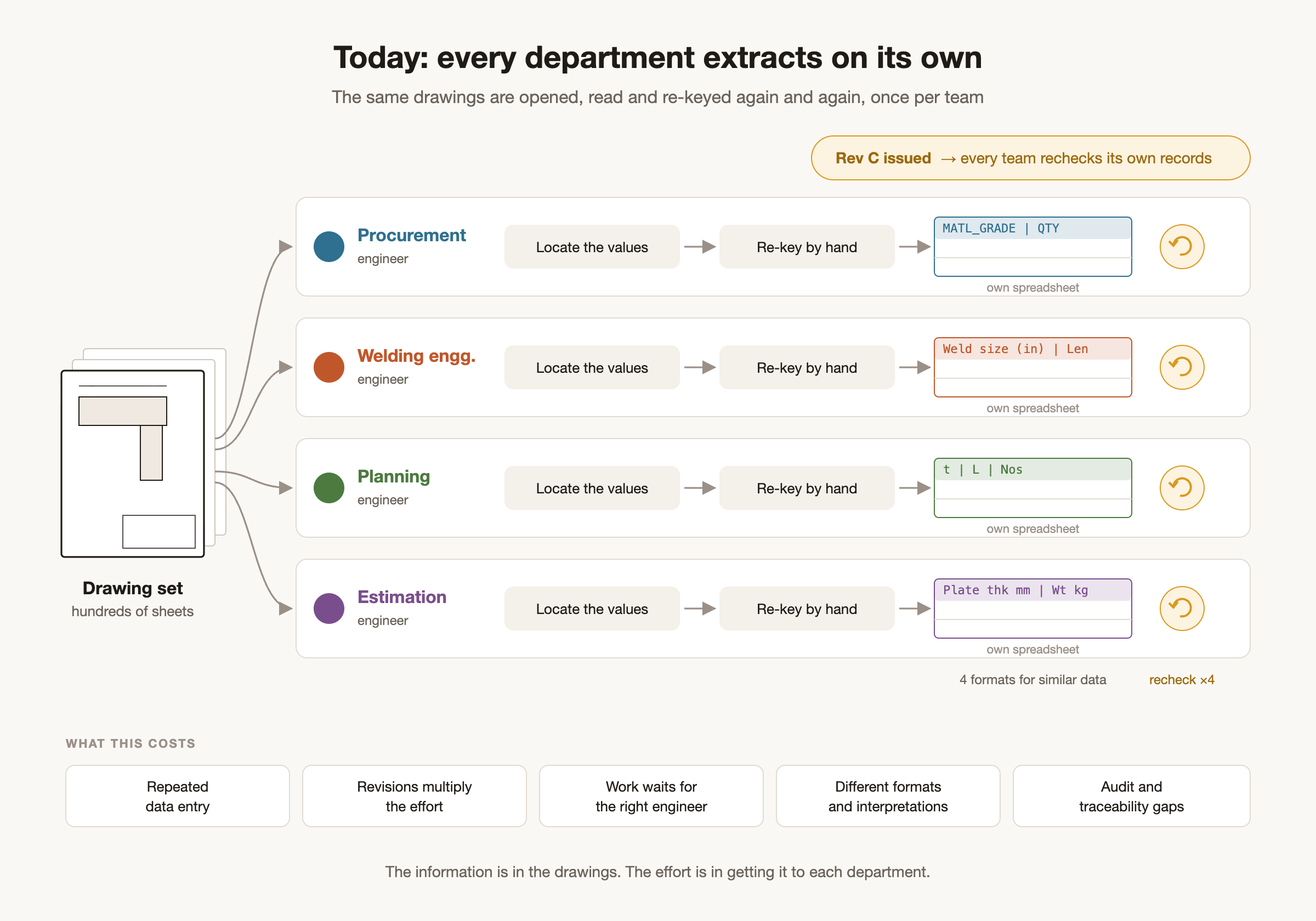 The information comes from the same source, but the requirements are different. Extracting everything from a drawing and handing it to every department does not necessarily help. Each team needs information organized around the work it performs.
Where manual extraction becomes a problem
When departments extract drawing data independently, the same work gets repeated. This creates several practical problems.
-
Repeated data entry
Engineers spend time locating dimensions, and entering into spreadsheets or business systems. Across hundreds of drawings, this becomes a significant amount of duplicated work.
-
Revisions multiply the effort
- When a drawing changes, each department must identify the revised information, compare the new revision with its previous records, and update the spreadsheets or business systems.
- As drawing and revision volumes grow, so does the workload.
-
Work waits for the right engineer
- When a dimension, symbol, or technical note needs clarification, progress can stall until the engineer is available.
- The required context may exist in an earlier revision, an email, or an individual's experience, but finding and validating it takes time. Reviews and downstream decisions are delayed.
-
Different formats and interpretations
- Each department often maintains their own spreadsheets, field names, units, and reporting formats.
- Different engineers may record the same information differently or overlook a critical characteristic.
- Consolidating these records creates additional work and makes consistency harder to maintain.
-
Audit and traceability gaps
- QC Teams may need to trace records across PDFs, spreadsheets, emails, and systems to verify whether process documents reflect the released design.
- The information exists, but the links between source drawings and downstream records are not always maintained.
Using ADEOS across departmental workflows
ADEOS approaches drawing extraction differently. Rather than applying one fixed set of extraction rules to every requirement, it allows extraction to be configured around the needs of individual departments.
Teams can define the dimensions, labels, abbreviations and other characteristics they need from engineering drawings. ADEOS uses these requirements to identify and extract the relevant information and organize it in the required output format.
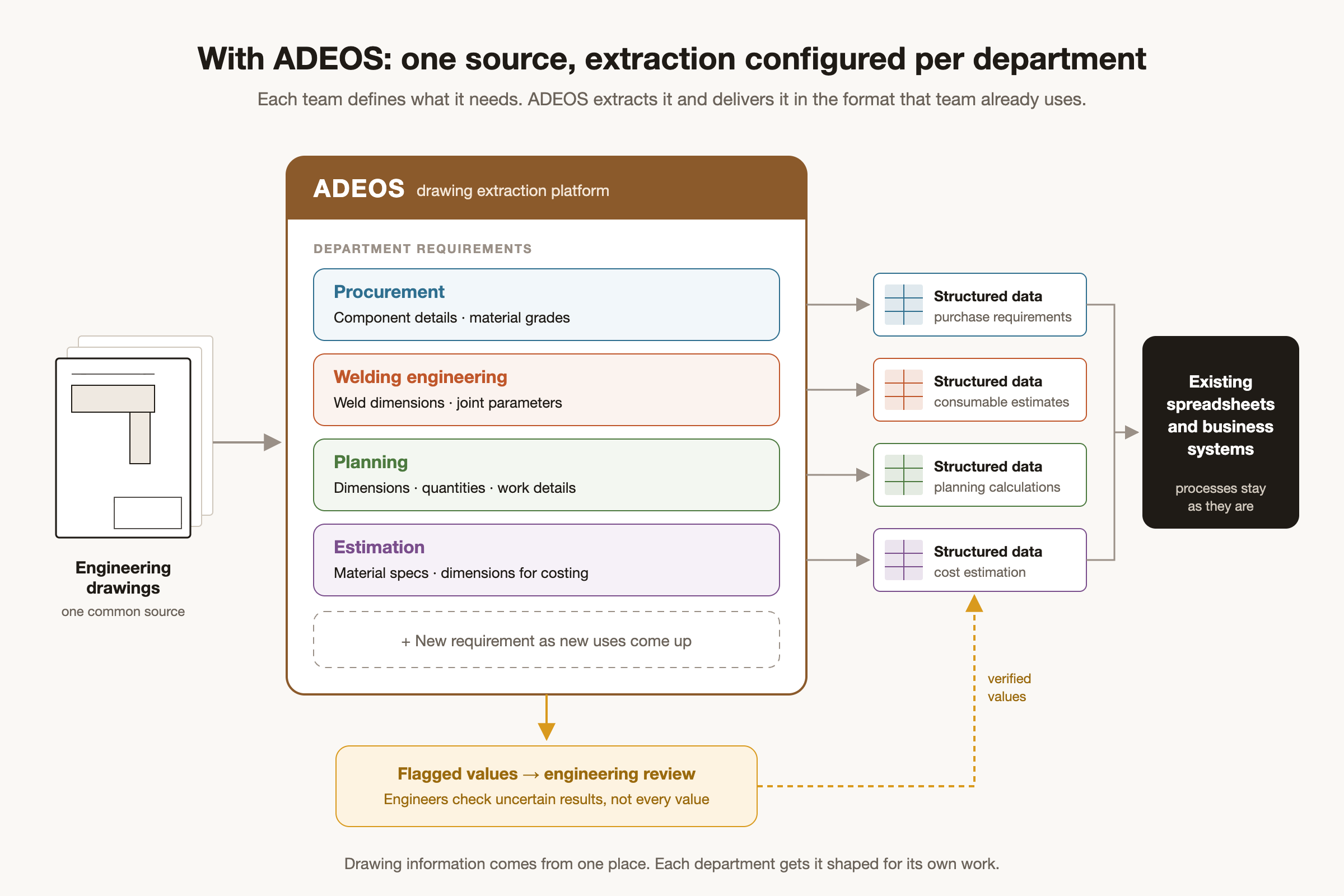 For example, a procurement requirement can focus on component details and material specifications. A welding engineering requirement can focus on weld dimensions and joint parameters. Planning and estimation can use different sets of dimensions and quantities from the same drawing.
The extraction requirements are configured around the intended use of the data. This means departments do not have to work through an unfiltered list of drawing information or depend on a common output that may not suit their calculations.
Values that need further attention can be flagged for engineering review. Engineers can then check uncertain results instead of manually locating and recording every value.
This approach also allows new extraction requirements to be introduced as departments identify additional uses for engineering drawing data.
Getting the data into existing processes
Extracted information is useful only when teams can put it to work.
Dimensions, quantities and material specifications can serve as inputs for calculations, estimates and other engineering activities. ADEOS structures these values into the required output formats, allowing departments to use them in their existing spreadsheets and business systems.
For instance, extracted dimensions can be used in planning calculations, while material details can support procurement requirements and cost estimation.
This does not mean departments need to change all their existing processes or replace the systems they already use. ADEOS provides a way to move information from engineering drawings into those processes with less manual effort.
As more departments use the platform, extraction requirements can be managed around their respective needs while drawing information continues to come from a common source.
Taking drawing extraction beyond individual tasks
In a large manufacturing operation, engineering drawings pass through several departments before the associated work is completed. Each team depends on information from these documents, often at different stages and for different reasons.
Building separate extraction processes for every department can create more systems to maintain and more opportunities for inconsistent records.
A shared platform offers another approach. Departments can define their own requirements, use the same engineering documents as their source and receive structured information for their respective activities.
As requirements change, extraction configurations can be updated without treating every new use case as a separate project.
The result is a common capability that can support different engineering and manufacturing activities while allowing each department to retain its own working process.
Conclusion
Engineering drawings are shared across departments, but the information extracted from them is often managed separately. This leads to repeated work, additional effort during revisions and inconsistencies between departmental records.
ADEOS brings these extraction requirements onto a common platform. Each department can specify what it needs, extract the relevant information and receive structured data for its existing processes. Engineers can focus their attention on reviewing values that need technical validation.
At Coffee Inc., we are building ADEOS to support engineering teams across manufacturing, making drawing information accessible and usable beyond the department that first extracts it.
One drawing can support many departments. The effort of extracting its information should not have to be repeated by every one of them.
To explore how ADEOS can support your engineering workflows, write to us at coffee@coffeeinc.in.