Read with Claude
 Read with ChatGPT
Jujutsu Kaisen is one of my favorite anime. I think its hard to go by these days without having watched atleast one, and that journey began for me with this anime. The story follows high school student, Yuji Itadori, as he joins a secret organization of Jujutsu Sorcerers to fight demons and protect humanity from Cursed Spirits.
But hold on, while I can go on and on about the anime, this isnʼt about the seriesʼ storyline, but about the learnings we can take from that anime. There are so many parallels that I could see that reflected in the real world, but the ones I wanted to discuss about revolves around Yuji and his decisions.
Snap Decisions, Long lasting Consequences
One of the pivotal moments that happens in the opening of the anime. To protect a fellow student, Yuji consumes a powerful Cursed Object, the finger of Sukuna, the King of Curses. This act binds Sukuna’s soul to Yuji’s, making him a unique case among sorcerers.
Yuji makes a quick decision to solve the immediate problem, without anticipating how drastically it will change his life.

That is how it goes in real life too. Sometimes, we make choices based on what seems right in the moment, only to realize later just how many layers there were to the situation.
Whether it is kicking off a new project, mapping out a plan, or making a decision under pressure, things usually start with a rough idea. We set things in motion, commit resources, and move forward, thinking we have got a solid path ahead.
Sometimes, we make snap decisions to solve a problem, only to realize later how much they change everything.
But just when things seem to be running smoothly, new challenges emerge. As the work progresses, deeper questions arise, and suddenly, what once seemed like a solid plan starts to feel incomplete. The team may have built something functional, but now there is a need for more flexibility, more scalability. That is when adaptability becomes really important. Because no matter how well we plan, the unknown always finds a way in.
No matter how well we plan, the unknown always finds a way in. The real skill is adjusting when they do.
Prioritization Over Impulsiveness
Not every battle can be fought at once, and Yuji quickly learns this. Rushing in without a plan could cause more harm than good. Some decisions, if made impulsively, can drain resources or lead to technical debt, much like the Yuji initial choice to consume the cursed artifact without knowing its full implications.
Not every problem needs solving right away. Focus on what moves the needle first.
It’s not just about being adaptable — it’s about knowing which challenges to tackle first. Resources are finite, and prioritization ensures that energy is spent where it matters most.
Leverage Play: Strategic Sacrifice
One of my favorite scenes in the series is when Ryomen Sukuna takes control of Yuji Itadoriʼs body and removes Yujiʼs heart. Being the King of Curses, Sukuna can stay alive without a heart. However, if Yuji regains control, he will die and in the process, Sukuna will lose his vessel. Why Sukuna would do this, considering Yujiʼs body is his only way to freedom? Why take such a risk?
Every decision comes with consequences, and in any complex project, we might be forced into a situation to negotiate.
This situation can be described as a “strategic sacrifice” or “calculated risk.” Every decision comes with consequences, and in any complex project, we might be forced into a situation to negotiate. Some choices, like Sukuna’s, prioritize dominance, forcing Yuji into a position where he must negotiate or perish.
We might arrive at a situation where the chosen technologies, frameworks, or strategies fail to scale as the project evolves pushing us into a corner. The choice needs to be made to scrape the whole project and rebuild from scratch (losing all the effort and time invested) or settle with what we have and build from there. The key is not just reacting but anticipating and recognizing early signs of friction, scalability issues, and limitations before they become insurmountable.
Every major project faces a moment of reckoning. The difference between failure and success often lies in how well we prepare for and navigate that moment.
Understand: Decision-making isn’t just about immediate gains. It is about anticipating consequences and preparing for the unexpected.
Defining Boundaries: The Binding Vow
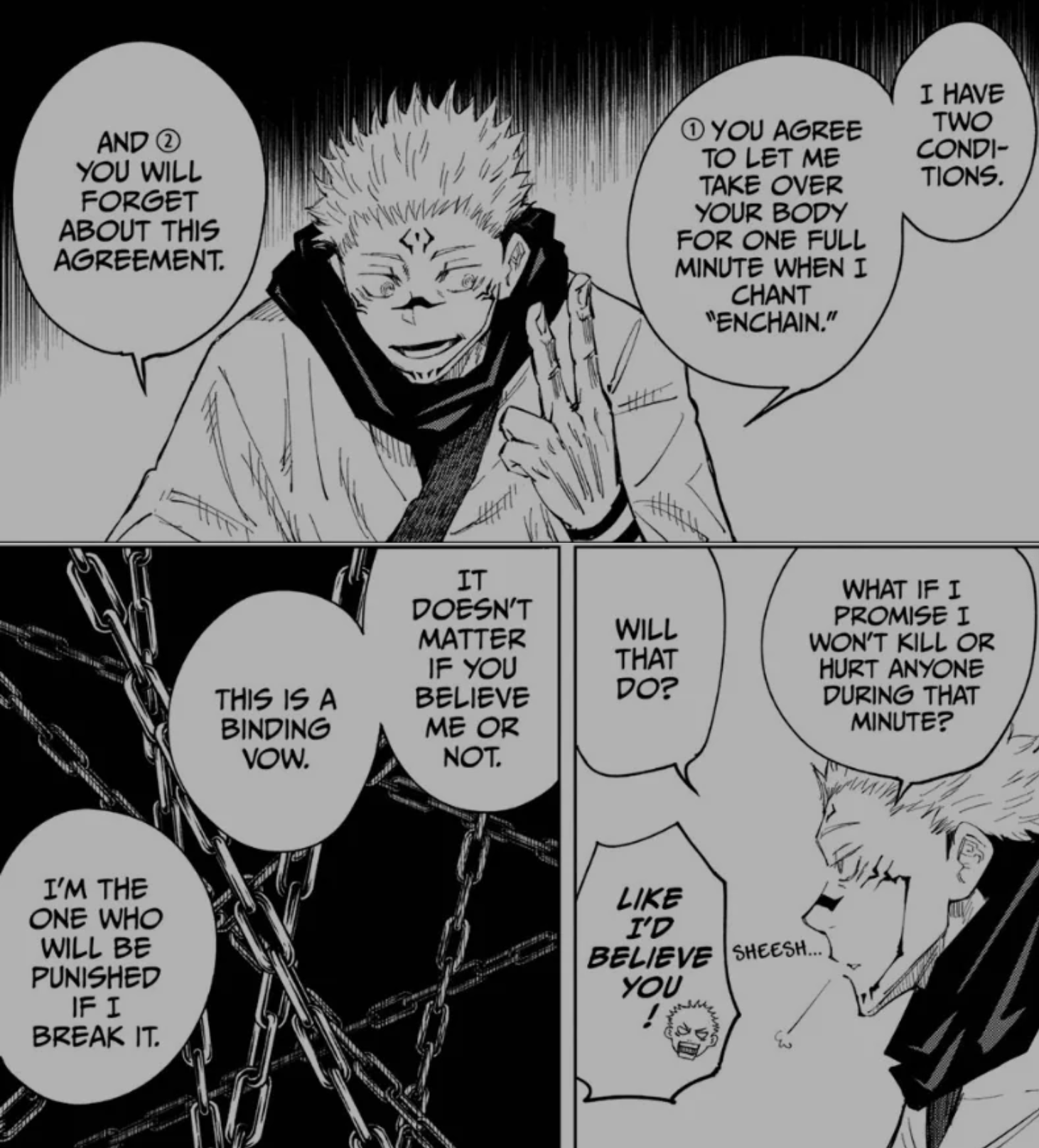
So, how do Yuji and Sukuna move forward? They establish a binding agreement, where the demon gains temporary control under strict conditions but cannot harm those close to Yuji.
We often face situations where complete control is not possible, and compromise is necessary. Just like Yuji, who must balance Sukuna’s power, we must define clear boundaries to mitigate risks while still making the best use of available resources.
Setting expectations upfront — whether with a demon or a stakeholder — prevents confusion and risk.
If teams aren’t aligned, things get messy fast. Clear goals keep work efficient. We must align goals across teams, ensuring that decisions benefit both immediate needs and long-term vision. A lack of alignment can lead to inefficiencies, just as an unchecked demon could cause chaos.
Closing Thoughts
Our biases, experiences, and limitations shape how we interpret challenges and make decisions. Much like Yuji and Sukuna navigating their uneasy partnership through structured compromise, we must balance stakeholder expectations, team capabilities, and unforeseen risks while staying realistic about constraints.
Success isn’t about avoiding risks, it is about making informed choices, adapting when necessary, and ensuring alignment in the face of uncertainty. Whether in anime or real life, the key to resilience is mastering the art of strategic decision-making.
And just like Yuji, the best way forward isn’t just about fighting harder, it is about fighting smarter.