Read with Claude
 Read with ChatGPT
we are in the middle of one of the largest enterprise technology shifts since the rise of the internet and cloud computing. markets worth trillions, industries reshaped, work redefined. yet if you look beneath the surface, enterprise AI initiatives struggle to keep up with the pace of AI innovation.
pilot to prod enterprise AI (generated by
gemini)
there is a vision gap at the top, as leaders struggle to set AI goals with the aim of also driving measurable results. organizations understand they must create an innovation-forward culture to get ahead. but many lack the proper guardrails needed to innovate safely at scale.
the core blockers are not the capabilities of the AI models themselves. it is how enterprises are, or are not, adapting their systems, structures, and people. while use of AI is rising rapidly across business functions, fewer than a third of organizations have adopted the practices needed to scale it effectively. the gap between experimentation and enterprise-grade value is widening.
expectations of enterprise AI
let us look at an enterprise AI tool as a function. every function has an input and an output. the problem is, in the enterprise, both input and output must conform to very specific formats and work with existing systems. you cannot just hand someone a clever result if it does not look, feel, and work with what is already there.
organizations tend to stick with familiar tools and systems. so they might expect tools to be something like they have already used, which gives convenient results and a similar experience. understanding organization needs, beyond their requirements, gives us what direction we can move forward in and what approaches to build the tool.
while there are cases we can match the experience, in others, there is no choice but to break the norm. in both cases, it becomes crucial on easing users across the organization into the system and provide support ready in case they get stuck.
the use-cases of enterprise AI
the initial hesitation surrounding enterprise AI is very similar to the early days of cloud computing. a decade ago, many organizations were doubtful about trusting core operations to the cloud. now, it is the most crucial and the core foundation of digital infrastructure throughout the world. AI is on a similar adoption curve, after a period of exploration, businesses are now getting serious about moving from experiments to production ready systems.
to do this successfully, it is crucial to understand the two primary ways AI is deployed in an enterprise:
horizontal use-cases
horizontal use cases are very common in organizations to boost & assist their internal team, specifically across the domains in the organization i.e., procurement, testing, development, sales, data analysis etc.
- they are generic ai tools which can be used by anyone in the organization.
- examples: microsoft 365 (copilot), google workspace etc.
these tools are useful, but their value is often shallow because they try to serve everyone at once.
vertical use-cases
vertical use-cases are for specific, domain oriented tasks. unlike horizontal use-cases, these systems are focused on domain-specific data to master a narrow set of tasks with high accuracy and efficiency.
- these are specific AI tools that handle one set of tasks alone.
- example: customer support agent which helps serving customers by answering their queries, research assistant for curation and brainstorming from the web.
these are harder to build but far more transformative.
horizontal tools are excellent for boosting general productivity. vertical AI tools not just assist a business function, they are deeply embedded within the core workflow. they solve a specific, high-value problem to work along with, which results in the true transformative value such as major cost savings, efficiency gains, and revenue growth.
characteristics of successful systems
building a successful AI system isn’t as simple as using mainstream tools like ChatGPT for business use-cases. it is because out-of-the-box models (generalist) lack the deep context and specialized skills needed for domain-specific enterprise tasks.
so, what makes a system a good fit for an enterprise? here are few of traits of such systems:
1. product-value fit
enterprises do not adopt AI for novelty, they adopt it to solve problems that matter. a system that showcases technical brilliance but fails to address a real pain point will not survive.
production-ready AI must align directly with business priorities: optimizing processes, increasing efficiency, and creating measurable revenue opportunities. it should be useful and add value to users in the organization and the enterprise as a whole.
2. integration ready
most enterprises already have workflows in place for the flow of data across the organization. the AI tools that blend well with the organization’s workflows are the ones that are adopted easily.
integration to existing tools reduces the fragmentation of data and knowledge and lowers the need for a separate learning curve.
3. reliability
enterprises cannot afford tools that work well in a demo, but fail under real-world pressure. reliability means consistent performance across diverse scenarios, consistency in the face of unexpected inputs, and the ability to handle edge cases, anomalies gracefully and finally the well-known problem hallucination.
a reliable system builds trust: employees depend on it, managers plan around it, and leaders commit to it. eventually it won’t just be assisting the team (if it was built for internal use-case in the org), instead it works along with them.
4. knowledge-retention
tools that are able to learn, also should possess extended memory to load up all information have been collected throughout the runtime without overwhelming the AI models session. they need to learn continuously from past interactions and recall information for correct context.
this is great for business use-case where enormous amount of data flows through. memory makes the system more reliable by preserving context across interactions, preventing knowledge loss from employee turnover, and enabling continuous improvement through accumulated insights.
5. domain-oriented
a generic model doesn’t know what an organization’s internal terminologies (which is defined by the internal team) are or why it matters. this involves embedding detailed instructions and examples directly into the model. this is also known as context engineering.
by giving the AI a clear role, rules, and examples, we dramatically improve its accuracy without any major techniques like re-training. this enables the most important factor for vertical use-cases.
6. adaptability and scale
an adaptive system is one that can evolve with respect to new data, changing business requirements, and continuous user feedback. this is not just about handling more volume, but about becoming smarter, more context-aware, and more aligned with the enterprise’s dynamic environment over time.
this ensures the AI tool remains a valuable, long-term asset that grows with the business, rather than a static piece of software that will become out-dated soon.
7. predictable costs
scaling ai is as much a financial challenge as it is a technical one. unclear pricing, unpredictable compute demands, or runaway usage costs reduce trust and stall adoption.
enterprises need certainty: transparent cost models, predictable scaling economics, and clear return on investment. only then can ai move from experimental budgets into core operational spending.
conclusion
most enterprises are still playing around with AI like it’s a new toy, and wondering why their multi-million dollar “AI transformation” isn’t moving. the successful ones aren’t doing anything magical. they pick one specific problem, understand their organization’s actual workflows (not what they think they are), and build something that integrates, scales, and adapts. they treat AI like a tool, not a replacement.
the pilot stage AI tools for horizontal or vertical use-case are a lot, but bringing into the real-world use-case, where edge-cases will increase by 10x, needs proper planning of the system.
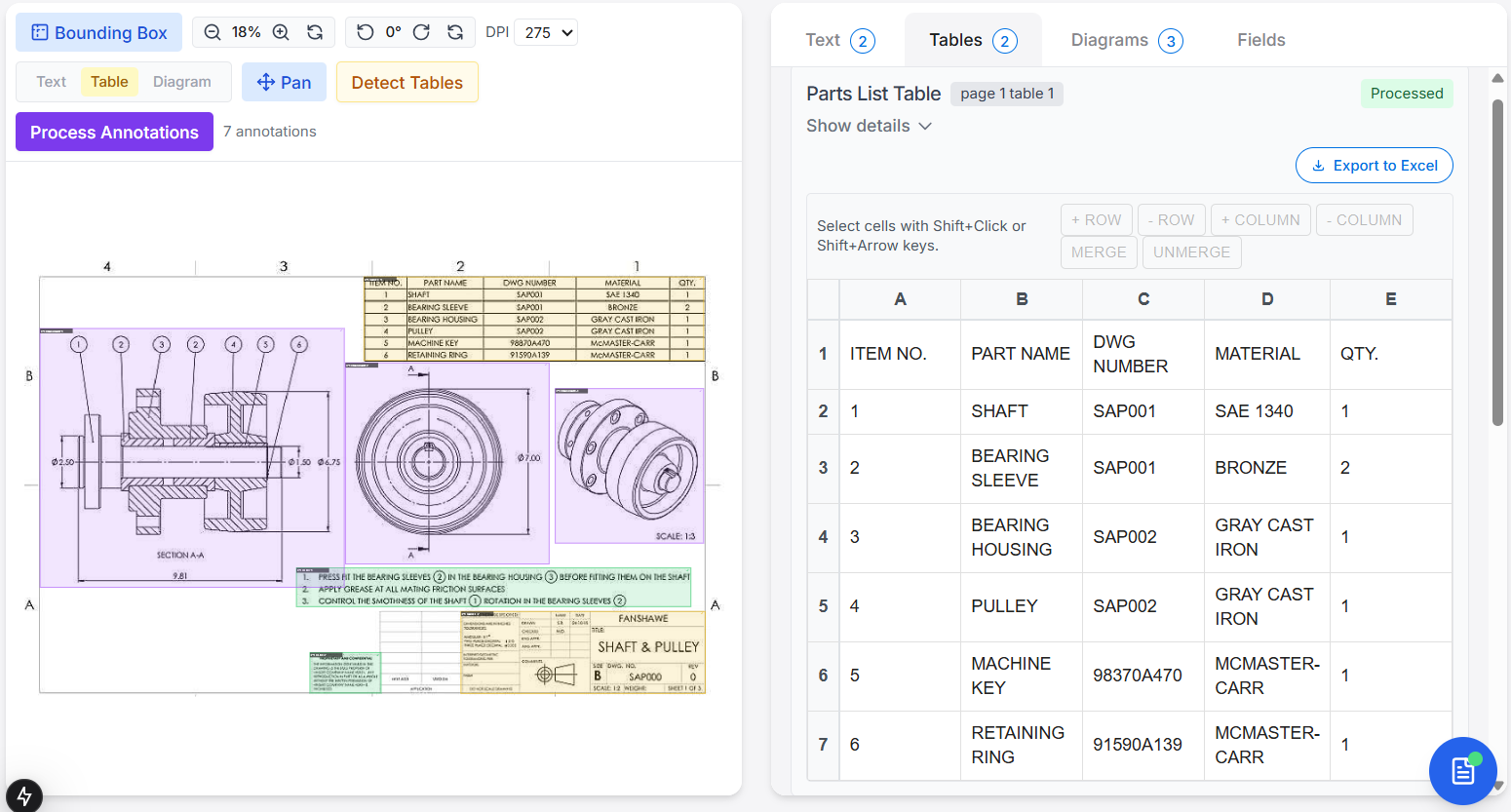
from my experience with ADEOS, an engineering-focused, agentic document extraction tool, I have seen these principles in action. ADEOS helps digitize complex manuals for vertical use-cases and, via apis, can power horizontal applications such as extracting dimensions from engineering drawings, querying documents through chat (RAG), or pulling specific fields, demonstrating how AI can be applied thoughtfully and effectively.
At Coffee, we are working on Adeos, an agentic document extraction tool, that can be used to extract key information from engineering drawings built with enterprise use-cases in mind. If you are interested to learn more, reach out to us.