HomeCase StudiesAutomated Balloon Annotation for Engineering Drawings
Aerospace, Automotive, Precision ManufacturingDocument Intelligence Platform

Automated Balloon Annotation for Engineering Drawings

Adeos detects and numbers every drawing callout in minutes, generating AS9102 and PPAP-compliant inspection packages automatically.

Drawing annotation time reduced from two to four hours per sheet to under five minutes for standard drawings
Detection coverage of 90 to 95 percent of annotatable callouts on drawings with adequate print quality
Duplicate and missing balloon numbers eliminated across processed drawing sets
< 5 min
Annotation Time
90–95%
Detection Coverage
3–5×
Throughput Increase
Eliminated
Numbering Errors
Objective

Objectives and Metrics for Success

The quality team wanted to eliminate the manual overhead of ballooning complex drawings while ensuring 100% traceability for AS9102 and PPAP compliance. The goal was to transform a multi-hour manual markup task into a minutes-long automated workflow with structured data output.

Challenge

The Problem

High-complexity engineering drawings required hours of manual annotation by senior quality staff, creating a persistent bottleneck in production releases and supplier qualifications. Missed callouts and numbering conflicts often led to costly re-inspections.

High Time Cost Per Drawing

A single complex drawing can take two to four hours to balloon manually, creating a delay between drawing receipt and inspection readiness that compounds across high-volume programmes.

Annotation Errors and Non-Conformance Risk

Missed or duplicated balloon numbers cause inspection records to reference incorrect characteristics, which delays approval and can trigger re-inspection or non-conformance reports.

Standards Compliance Burden

AS9102 First Article Inspection and PPAP submissions require every drawing characteristic to be ballooned and traceable. Manual processes make it difficult to verify completeness and maintain an auditable record.

Methodology

The Approach

The deployment moved from initial format calibration to a live pilot on representative production drawings, ensuring the automation logic matched the specific callout styles of the engineering team before full rotation.

1

Drawing Format Analysis and Scope Definition

Drawing samples were collected across formats and complexity levels. Annotation scope was defined including which characteristic types required ballooning and what output structure was needed for compliance.

2

VLM Calibration and Detection Tuning

Adeos was calibrated against the drawing sample set to optimise callout detection coverage, reduce false positives on reference dimensions, and establish confidence thresholds for human review flagging.

3

Checklist Template Configuration

Inspection checklist output templates were configured to match AS9102 and PPAP documentation requirements, including characteristic type classification and drawing revision traceability.

4

Production Deployment and Workflow Integration

The system was deployed for live drawing intake, with annotated outputs and checklists delivered to the quality team for use in ongoing First Article Inspections and supplier qualification packages.

Implementation

The Solution

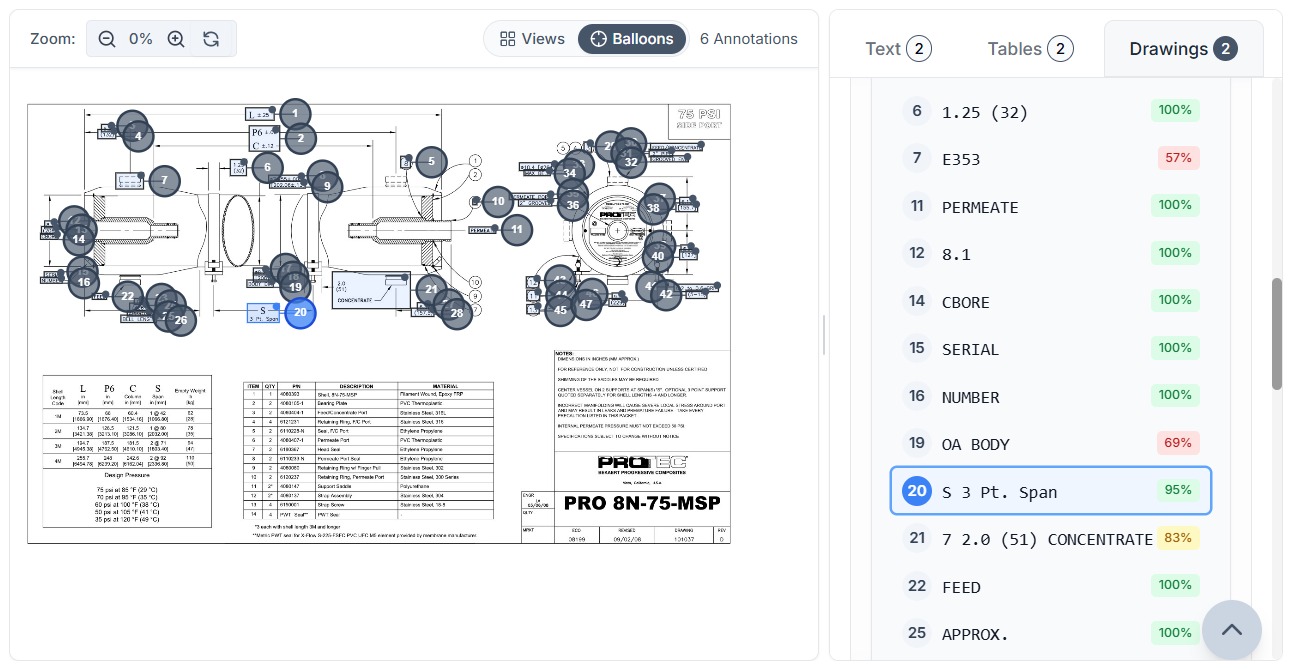
We deployed Adeos to analyze, number, and annotate callouts across multiple drawing formats. The system automatically links every balloon to a structured inspection checklist, creating a digital-first quality record that flows directly into regulatory documentation.

Callout Detection Using Adeos

The VLM engine parses each drawing to locate dimensions, tolerances, surface finish callouts, datum references, and notes across all views, distinguishing annotatable characteristics from reference dimensions and general notes.

Sequential Balloon Numbering and Placement in Adeos

The system assigns sequential balloon numbers in a consistent reading order and places markers adjacent to callouts without obscuring drawing geometry. Numbering remains stable across re-runs, ensuring revision consistency.

Structured Inspection Checklist Export

Each annotated drawing is paired with a structured checklist mapping every balloon number to its characteristic type, nominal value, and tolerance, formatted for AS9102 First Article Inspection reports and PPAP packages.

Multi-Format Drawing Ingestion in Adeos

The pipeline accepts PDF, scanned image, and CAD export formats. Pre-processing normalises resolution and orientation before analysis, enabling the same workflow to handle legacy and current digital drawings without separate handling.

The Results

By automating the tedious ballooning process, the quality team achieved a 3-5x increase in drawing throughput. Manual errors were eliminated, and First Article Inspection packages are now ready for review in under five minutes.

Drawing annotation time reduced from two to four hours per sheet to under five minutes for standard drawings

Detection coverage of 90 to 95 percent of annotatable callouts on drawings with adequate print quality

Duplicate and missing balloon numbers eliminated across processed drawing sets

AS9102 and PPAP-compliant inspection checklists generated automatically alongside annotated drawings

Quality teams processing three to five times more drawings per day without additional headcount

Consistent balloon numbering maintained across drawing revisions, reducing reconciliation effort

Insights

Key Learnings

Standardizing scan quality and focusing on structured data output proved essential for regulatory compliance. We learned that while AI handles the bulk of the work, keeping a human-in-the-loop review stage maintains the highest engineering accountability.

Drawing Quality Determines Detection Coverage

Scanned drawings with poor resolution or physical damage require pre-processing before analysis. Establishing a minimum scan quality standard at drawing receipt reduces handling downstream.

Compliance Requires Output Structure, Not Just Annotation

AS9102 and PPAP compliance depends on the inspection checklist structure as much as the annotated drawing itself. Characteristic type classification and revision traceability must be built into the output, not added after the fact.

Human Review Remains Part of a Sound Workflow

The system flags items it cannot annotate with high confidence for engineer review rather than omitting or guessing. This preserves engineer accountability for the final inspection record.

Stable Numbering Across Revisions Reduces Re-Inspection

Inconsistent balloon number reassignment between drawing revisions makes inspection records difficult to compare. Numbering logic tied to drawing geometry rather than arbitrary sequence preserves continuity across the part lifecycle.

Conclusion

Automating the ballooning process has fundamentally changed the speed of quality documentation for our aerospace and manufacturing clients. Adeos doesn't just save time—it increases the reliability of the entire inspection record. By removing the administrative burden from quality engineers, organizations can now focus on engineering excellence and part performance rather than manual markup.

See Auto-Ballooning on Your Drawings

If your team manages First Article Inspections, PPAP packages, or drawing-intensive supplier qualifications, Adeos can demonstrate automated balloon annotation on your own drawing samples.